The Very Middlemost Word

Were you enchanted by the word and number play of The Faerie Queen, too, Word Fans?  I’m pleased to report that by word count, and including Chapter titles, the very middlemost word of The Hobbit is “creeping”.

[08.058]  After a good deal of creeping and crawling they peered round the trunks and looked into a clearing where some trees had been felled and the ground levelled. There were many people there, elvish-looking folk, all dressed in green and brown and sitting on sawn rings of the felled trees in a great circle. There was a fire in their midst and there were torches fastened to some of the trees round about; but most splendid sight of all: they were eating and drinking and laughing merrily.

Pivotal  moment?  Yes, indeed!

What the Lexos Graphs Tell Us

To explore how to use the graphs created by Lexos, let’s supplement the great documentation on their web site focusing just on what we need for this project.  Lexos looks at a rolling window, which means this:  What if we said, “Looking for the word “IN”, looking in blocks of five words, where do we find our target word?

  • Block 1: In a hole in the – 2 instances of “IN”
  • Block 2: a hole in the ground – 1 instance of “IN”
  • Block 3: hole in the ground there – 1 instance of “IN”
  • Block 4: in the ground there lived – 1 instance of “IN”
  • Block 5: the ground there lived a – 0 instances of “IN”

If we were standing in the book on the word “hole”, each block that contains that word (blocks 1, 2, and 3) would be considered and the number of instances averaged (2 instances, 1 instance, 1 instance,  – average = 1.33).  That’s a rolling average with a window of five, considered from the point of the word “hole”.

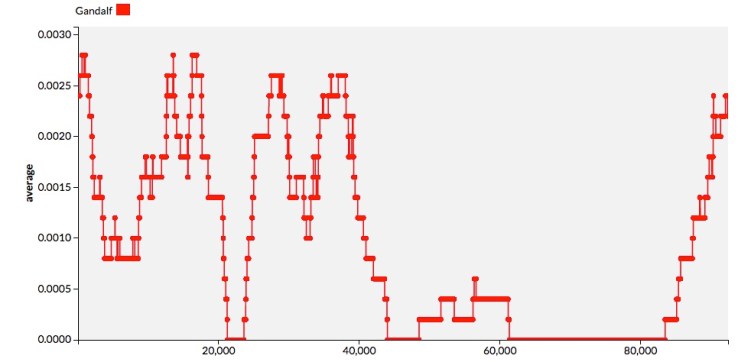
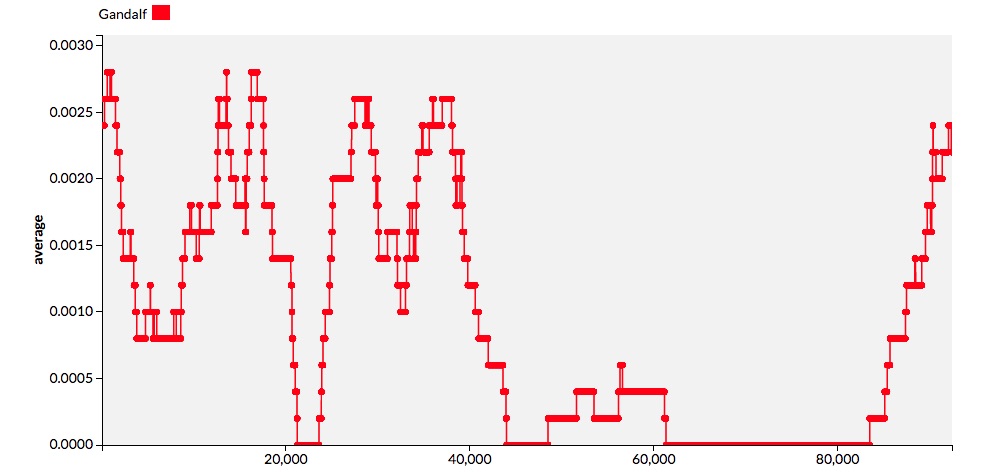
Oy.  It is too much.  I shall sum up with a picture.  I asked Lexos to create a graph of the instances of “Gandalf” in the text with a window of 100 words.
GandalfGraph5K

Those are word numbers along the x-bottom axis, which is why we made a word-number-to-chapter-break table in our previous post.  See that gap around word number 44,000?  That’s when he leaves Thorin & Company at the edge of Mirkwood!  Those small spikes between 55,000 and 65,000 are three references to Gandalf, not descriptions of the wizard’s actions or words such as:

[09.031]  ‘Upon my word!’ said Thorin, when Bilbo whispered to him to come out and join his friends, ‘Gandalf spoke true, as usual! A pretty fine burglar you make, it seems, when the time comes.”

Then at 85,000 Gandalf re-enters the action of the book!  We can see the action of the book in the graphic!  I’m so excited that there was a bit of jumping up and down here at Taigh Connlaich when I saw the first lovely picture!   The gap in “Gandalfs” around word 21,000 is, of course, Chapter 5.  Now that we know how to glean information from the Lexos graphs, hold on to your hats.  Tomorrow, Word Fans, we will graph our categories of tagged words!
Words per chapter

When we look at our graphs from Lexos, it’s going to be very useful to know where the Chapter breaks are in the stream of words. For curiosity, of course, I’ve also listed the number of words per chapter.

Chapter ends on word Words in Chapter
One 8,753 8,753
Two 14,029 5,276
Three 16,943 2,914
Four 21,024 4,081
Five 28,045 7,021
Six 34,801 6,756
Seven 43,874 9,073
Eight 54,127 10,253
Nine 59,986 5,859
Ten 63,946 3,960
Eleven 66,962 3,016
Twelve 74,141 7,179
Thirteen 78,082 3,941
Fourteen 81,334 3,252
Fifteen 84,716 3,382
Sixteen 86,876 2,160
Seventeen 90,836 3,960
Eighteen 93,662 2,826
Nineteen 96,154 2,492

Sound Play

I am preparing to graph the frequencies of those words which show sound play – which we have tagged “onomatopoeia” in the word entries.  I cannot but help to include all of Gollum’s extra-sibilant utterances as well as his call-name.  Given that I’m counting the name “Gollum” in this analysis, I must use the best sound-names of the whole novel, Roäc and Carc. Their names suggest the entire Raven language and a suspicion that we readers have heard ravens talking among themselves, not making simple sounds, an idea we have encountered before.

Including those names and Gollumisms, there are 488 sound-play words in our spreadsheet of 7172 uncommon words.

More corrections

How did I get in my head that the book’s total word count is 27,000?  In trying to replicate everything, I found I made this error a few times.  Grievous error.  There are just over 96,000 words in The Hobbit.  Good thing I caught it now!

Update 2015.06.20: I believe I have corrected all the countings and mathings up to this point.  Word Fans, please let me know if you see an error!

Food v Sound

There are forty three separate food words, about half as many as there are sound words.  They are repeated for a total of 125 food words, about one-third as many as there are sound words.  I have heard frequently about the food imagery – how it expressed the Baggins side of our reluctant hero – but not much if ever about the sound words.  Hmmm.  Is this a function of many food words being in the Ten Thousand?  Is it also a function of the sound words acting more subtly on us?

Our “Archaic” Tag

I am using the tag “archaic” to two purposes.  First, if the OED calls a word “archaic”, then “archaic” it is tagged!  Second, I am using it as an umbrella term to embrace the obsolete words and the rare words as well (as they are labeled by OED).  One tag to mean “old”.  If you see “rare” or “obsolete”, know that that’s the dictionary’s primary classification of the word in question (not that there aren’t a few words which have earned many different OED labels!).

Checking the Tags

Last weekend’s task, extending to today, is double-checking the accuracy of our tags.  I’m choosing one where two are closely related, two where I seem to have used one for different things on different days, making sure that every post has at least one tag.

All of this is preparation for tagging the original text in preparation for using Michael Drout’s fascinating lexomics software!  My goal is to see if Tech Support’s app works to replace several different words with the same tag, and if so to make at least my first lexomics run!

Firework

“Firework”, singular, is outside of The Hundred Thousand.  OED tells us that in its meaning as “a pyrotechnic display” although the plural “fireworks” only is used now, the singular used to be used.  Most instances in The Hobbit are of “fireworks” except one.  The uninflected form could be the older form for the meaning just cited – or could be the form indicating other, obsolete meanings of “firework” (work done in fire, a furnace, and others).  Of course… Tolkien uses it in paragraph 01.091 adjectivally, to describe the glare of the blue light on Gandalf’s staff.  OED admits of no adjectival uses, except as the first element in some hyphenated word phrases.  The word we know is tweaked so very gently off the rails – we can take nothing for granted, yet we do not know consciously that we have been alerted.  Absolutely elegant.

  • 01.017 such particularly excellent fireworks!
  • 01.018 You seem to remember my fireworks kindly,
  • 01.092 in its firework glare
  • 06.030 (even the hobbit had never forgotten the magic fireworks
  • 07.083 I would have given them more than fireworks!’
  • 14.013 No fireworks you ever imagined equalled the sights that night.

“ˈfire-work | ˈfirework, n.” OED Online. Oxford University Press, March 2015. Web. 5 June 2015.