“Smithereens” (an Irish word) and “carrock” (a Cumbrian word) as well as the Scottish words “delve”, “canny”, “uncanny”, and “bash” have been tagged “British” as in “a word from a non-English language of the British Isles”.
Author: lfsaldenbirch
Archaic word peaks
My advisor was intrigued to see the peak in archaic words at the beginning of Chapter 9. Here is the graph of those words superimposed on the uncommon word graph.

Since the archaic words are a subset of the uncommon words, we know that the scale must be smaller; in this case it’s about one-twentieth the scale of the red graph (who scale is shown over on the left). Where you see the red and green graphs equal, that means there’s one archaic word in every twenty uncommon ones.
While we have the leisure, let’s break down each of those archaic peaks.
- Archaic words in the troll peak: laden merrily merry canny lout glimpses merrily merry merry
- Archaic words in the leap-in-the-dark peak: glimpse orcs glimpse bewildered glimpsed
- Archaic words in Mirkwood: glimpses accursed merry merrily lob lob merrymaking eldest kinsfolk merrily merrymaking merry merry yonder merry merry kine mead glimpse merry
- Archaic words in Chapters 17 through the end: bewilderment kinsmen alas, kinsfolk merrily merry merrier merry bewildered elder wrought unwrought merrier merry merry merry laden merry merry merry merry merry merry elders
Well! We seem to have a merriment detector working for us! And the word merry we can use broadly as an elf-detector! Everything we have had to say about archaic words is tagged here, and the concordance entry for “Merry” is right here.
My original thought was that archaic words – tagged by the OED as “obsolete”, “archaic”, “rare”, “colloquial” – would indicate high register. These words certainly contribute – but their numbers are too few to be a robust finding. We will take the clue about elves and tuck it away for consideration.
1937 & 1951: What does the change in diction reveal?
Why does Tolkien use sound words more densely in the new 1951 paragraphs of Chapter 5 than in the earlier edition? As Corey Olsen says (2015), the caverns and tunnels are just as dark in 1937. In this project, we focus on register: what change in register did Tolkien achieve in his later edition? Gollum in 1951 is based on Gollum of The Lord of the Rings – more wicked, more tragic (Olsen 2012). The ring of invisibility, so convenient for burglars, must now hint of the menace and sleeping evil of the One Ring.
So. Wicked register, tragic, menacing, evil. Dangerous, slippery, slimy, decaying. Unclean, unwholesome. Tolkien used a thicker density of sounds, particularly hissing esses and Gollum’s just-a-bit-off sibilant speech, to create corrupt register. Our noses twitch with instinctive disgust. With our new tools, we see at the word level what other scholars assert at the plot, character, and concept level.
I suggest one more step back to an even wider view. We are reading Bilbo’s memoirs. In the 1937 edition, winning the riddle game was the high point of the uncommon words, the sound words, the danger, the excitement of the chapter. Bilbo’s writing thereafter is less intense, matching less-intense memories. In 1951, once leaving the sanctity of the riddle game, the danger increased and Bilbo, charged with the memory of adrenaline and excitement, wrote more vividly of the sounds which twanged his every taut nerve.
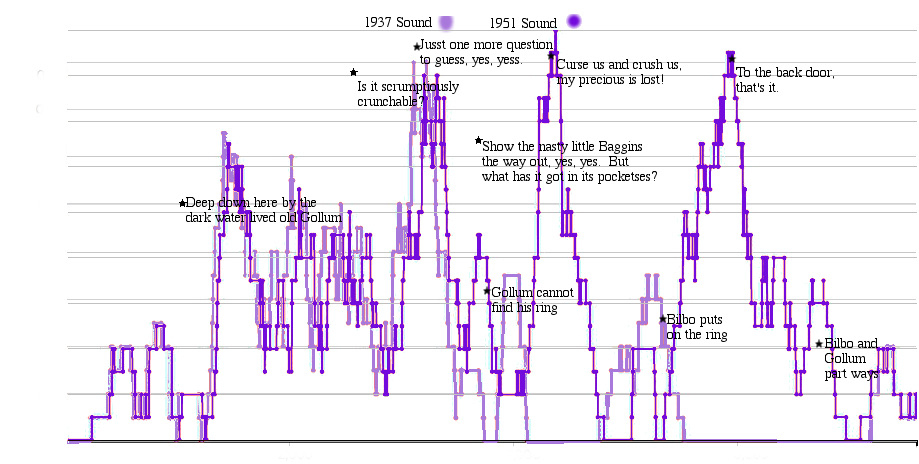
I observe that Lexos was developed to find the change in the hand which held the pen – to detect when a different scribe took over the copying of a manuscript by finding the patterns in the small differences in a few key penstrokes. In the difference between the lavender sound words of 1937 and the bright purple sound words of 1951, do we detect the difference between the hand of a hobbit making up an unremarkable story which he hopes no one will press him about and the hand of an older hobbit who understands that the true tale must be told and in writing it relives the adventure in its heart-stopping fullness?
‘Very well,’ said Bilbo. ‘I will do as you bid. But I will now tell the true story, and if some here have heard me tell it otherwise’ – he looked sidelong at Glóin – ‘I ask them to forget it and forgive me. I only wished to claim the treasure as my very own in those days, and to be rid of the name of thief that was put on me. But perhaps I understand things a little better now. Anyway, this is what happened.’
Olsen, Corey. Exploring J.R.R. Tolkien’s The Hobbit. Boston: Houghton Mifflin Harcourt, 2012. Print.
Olsen, Corey. Personal correspondence. July 5, 2015. email.
Tolkien, J.R.R. (2012-02-15). The Lord of the Rings: One Volume (p. 249). Houghton Mifflin Harcourt. Kindle Edition.
1951: How do sound words contribute?
Remember the 1951-new paragraphs? The mountains of uncommon words in bright red above the valleys of pale red? They are marked by the phrases “Show the nasty little Baggins the way out”, “Curse us and crush us, my precious is lost!”, and “To the back door, that’s it.”
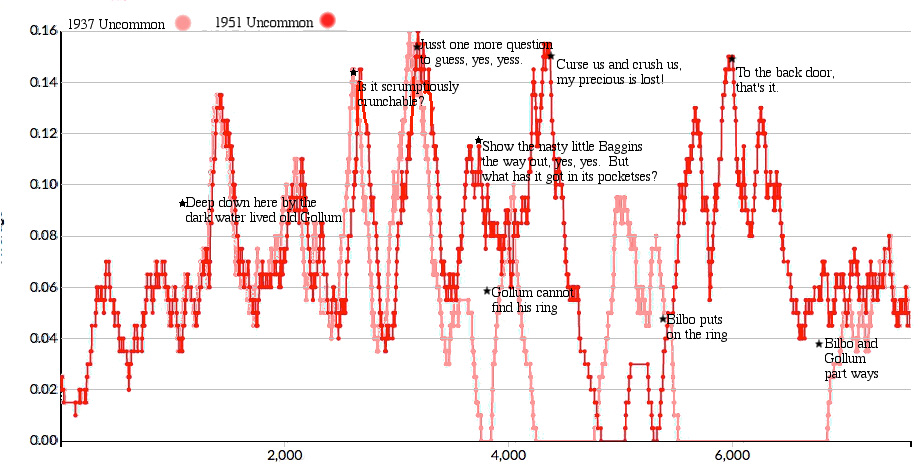
Got them spotted? OK. I’m going to take out the pale red 1937 line and put in the 1951 purple sound line. Ready?
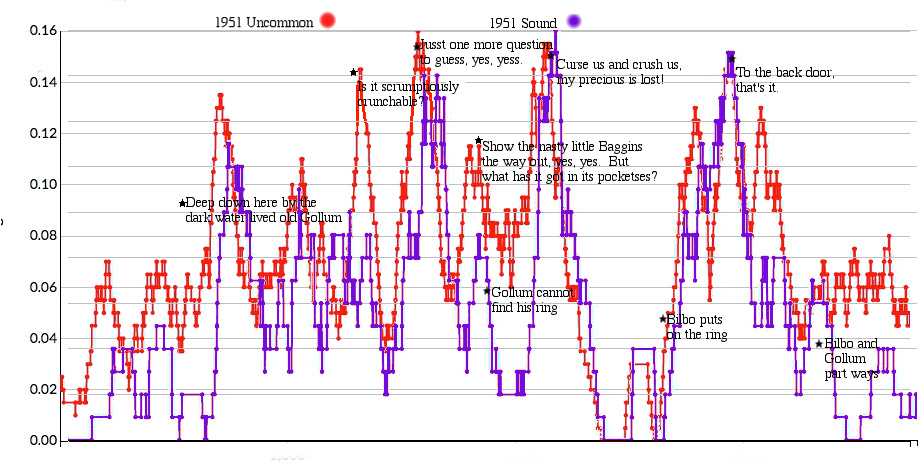
Great elephants! In 1937, the sound words dropped to about a third of the Riddle-Game-climax peak for the remainder of the chapter. Not so in 1951!
The sound words are not just frequent, they’re punching higher in frequency than they did before, and we see from the shapes of the graphs that the sound words drive the frequency of uncommon words. These sections – approximately paragraphs [05.080] to [05.132] – are the ones Tolkien added to tie this text forward to The Lord of the Rings as he was writing and discovering that longer, more complex work.
We’ve already listed the words which appeared in the 1951-only paragraphs but not the 1937-only paragraphs and vice versa; that would measure whether the new paragraphs were formed out of the words of the retiring paragraphs. There is another way to look at those unique-paragraph words, of course – to compare the new paragraphs of 1951 to the entire 1937 chapter. I’m pleased to report that list is almost the same as the previous.
Almost all of the new words, naturally, occur from paragraph 80 to 132. Here they are – the completely new uncommon words from 1951.
- Words we tagged as sound words (tagged by the OED, or from Gollum’s idiolect, or Gollum’s name and characteristic throat noise): cracking creepsy eyeses goblinses Gollum hates gurgling hissing losst screech shriek smells sniffed squeaked squeaker ssss tricksy
- other uncommon words (note how many begin with S): back-door betterment birthday-present blindly blood-curdling bowstring brooded crawling crouched dursn’t flattened forefinger galled gleamed gnaw goblin-imp groping hiding-place humped leapt maddened menacing menacingly mouse noser nosey oddments paddling palely panted peered pricked quicker shambling sharpened sharper sheathed shiver side-passages snag sneaking softer splayed squeezes stab stiffened swayed tripping tense tunnel-wall unlost unmarked
footnote: The scales are the same as last post’s graph lines – the red uncommon words line is on the 0.00 to 0.16 scale as shown and the purple sound line is on 0.00 to 0.09.
1937: How do sound words contribute?
We know that there are plenty of sound words in Chapter 5. How much do they contribute to the uncommon words of 1937?

That correspondence looks quite strong – and let me give you more grist for the mill. Lexos draws each individual graph at a scale that visually fills up the space for us to see the patterns clearly, it recalculates what the scale should be for every new graph. As I reminded us in the last post, in looking at the whole book, Lexos draws the purple sound graph at about 33% of the red uncommon graph: where the two lines match, for every 100 red uncommon words, 33 of them are purple sound words.
When we look only at Chapter 5, Lexos draws the purple sound graph at 56%: where the two lines match, for every 100 red uncommon words, 56 of them are purple sound words. The strength of the sound words’ contribution to our red graph is almost doubled.
Well, then. Chapter 5 is full to the brim with sound words! It’s certainly not unexpected, after all it’s dark in those caverns. Each sound is magnified, and it’s the strongest sense Bilbo has working for him to perceive his situation. Here’s a sample of how the sound words and the other uncommon words work together in a paragraph which is identical in both editions:
[05.007] ‘Go back? ‘ he thought. ‘No good at all! Go sideways? Impossible! Go forward? Only thing to do! On we go!’ So up he got, and trotted along with his little sword held in front of him and one hand feeling the wall, and his heart all of a patter and a pitter.
We can also notice that the “scrumptiously crunchable” peak is not particularly driven by sound words. That may or may not be of particular interest, but it does reassure us that the strength of the sound graph elsewhere is not an error, as we can see that it’s not omnipresent.
After the peak at the climax of the riddle game, we observe that the sound words recede to about a third of that peak.
Footnote: I have debated erasing those y-axis scales on the left hand side completely, yet I feel an obligation to make my Lexos graphs comparable to those produced by other scholars. The scale on the sound words, which I described above as “56%” is from 0.0 to 0.09. If you need to articulate those number sentences more clearly, “for every hundred words, 16 are uncommon, of which 9 are sound words”. I don’t have the skills to read the OpenSource code which the Lexos programmers wrote, but I used to be a statistician in the days of punch cards and carrier pigeons. If you ask me questions about the numbers, I can probably ask Tech Support to read the code and tell me the details so I can make a coherent explanation.
1937 & 1951: Do the uncommon words differ?
A few weeks ago, we noticed that the longest sustained high frequency of uncommon words takes place in Chapters 3, 4, and 5 – in Rivendell, captured by goblins, and with Gollum. Surely that’s not the rhetorical peak of the work – what is happening in these chapters? We examined those special word categories we’ve been tracking – archaic words, food words, and sound words – and found a huge peak:
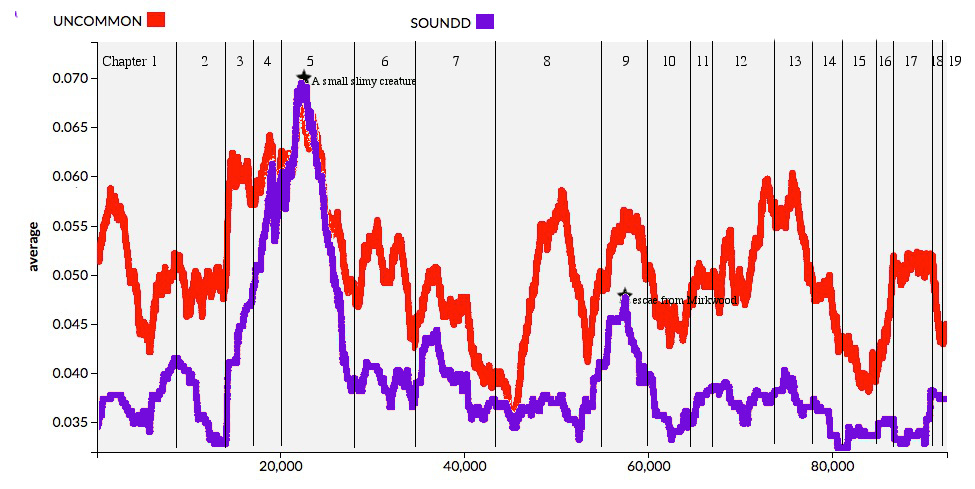
What was Tolkien doing with all those sound words – clearly the purple Sound Word graph drives the red Uncommon Words graph. We do remember that the purple line is on a 1/3 scale: when the purple and red lines match, the number of sound words is about 1/3 of the total number of uncommon words at that point. Although they’re not identical, the coincidence of the peaks at “a small slimy creature” and the similarity of the shapes of those peaks is suggestive.
Earlier I asked “How did Tolkien do that?” Today I ask… “How did he do it and what did he do?” Tolkien’s subtle hand with words operates on multiple levels. As Blackwelder observed:
We may assume that a reader is following the story and the characters and may sometimes fail to notice the unusual words, phrases, or even passages.
We come out into the sunlight at the end of Chapter 5 breathing a huge sigh of relief… when we were safe at home in our comfortable reading chairs the whole time. How did he use the words, phrases, and passages to effect us emotionally – subliminally?
Well then, let’s take advantage of the writing and publication history of The Hobbit and take a close look at Chapter 5, the chapter which we know he changed in order to change the facts and the feeling of the story. Here is the graph of uncommon words of Chapter 5 as it was written in 1937. For this much smaller sample, I used a rolling average on windows of 200 words.
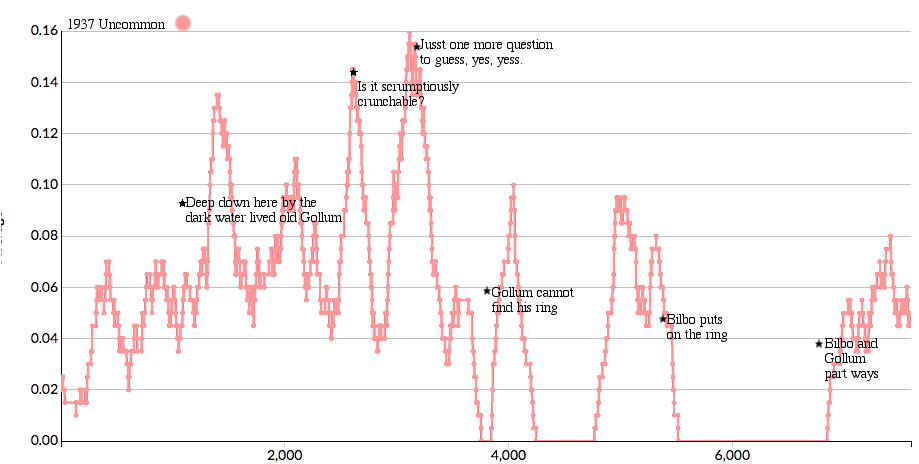
I’ve placed a few textual landmarks – I love that “scrumptiously crunchable” is one peak and that the highest frequency is right at the end of the riddle game as Gollum is waiting for Bilbo’s last question.
You can see an artificial valley right as Gollum cannot find the ring, another one from about word 4250 to word 4900, and the largest and last one after Bilbo puts on the ring which stretches until he and Gollum part ways. I call these “artificial valleys” because at these points the 1951 Chapter 5 has different paragraphs and I inserted the word “and” in each spot enough times to match those 1951 paragraphs’ word count without making a false image of uncommon words.
We’ve looked at which words are new in the 1951 edition (and which were lost from the 1937); are those words evenly distributed through the chapter? Keep your eyes on those artificial valleys as I show you the 1951 graph overlaid on this 1937.
Look at those valleys! Over all three 1937 valleys are towering 1951 mountains of uncommon words! When he wrote those extra paragraphs, Tolkien pulled out the stops. “Pocketses” and “Curse us and crush us!” In the “curse us and crush us” spot in 1937, Gollum repeats “bless us and splash us”! What effect did Tolkien accomplish and how did he do it? I’m going there in the next blog post.
You can even see the small artificial valleys in the bright red line where I inserted “and” in the 1951 to make up the word count from the extra 1937 paragraphs. Those 1937 paragraphs which were removed were definitely not peak word moments, they toddled along in a manner that looks pretty average for the rest of the chapter. Notice that the graphs remain the same shape but become disjoined during the riddle game? That follows a few spots where 1951 adds just a few words in just a few sentences, pushing that bright red 1951 line slightly rightward.
Comparing 1937 and 1951: PDF tool for scholars
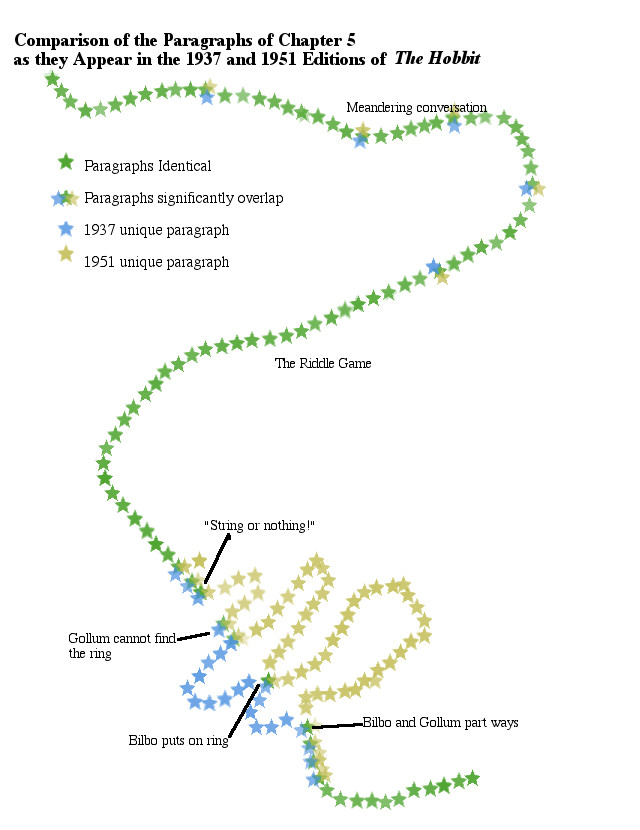
Here’s your own Paragraph Comparisons 37 – 51 as both a graphic and a text table in PDF form. I will link a copy on the About page as well. You will need the paragraph index from the About page to follow the text rather than just get the gist of the comparison.
Comparing 1937 and 1951: the graphic
You’ve heard that the 1937 and 1951 editions of Chapter 5 are quite different. Here’s our illustration of the comparison.
Concordance entries fixed for paragraph numbers.
You’ll recall that I made a little counting error in the paragraph numbering system – the errors were in chapters 1, 11, and 13. I think I’ve corrected them all; I’ll be pleased to hear of any errors you find.
An Update at Lexos
It looks as if the good folks at Lexos have released a small update – minor changes in the user interface and graphic rendering. New charts which the software draws for us henceforward will look slightly different; the points on our graphs will be smaller and clearer. The first thing I did with this new clarity was make certain that our graphs do run all the way to the end of the text. They certainly do – that very last uptick in food words represents exactly the words “kettle” and “tobacco-jar”.
 words that you were saying