A Little Mythgard Swag

… for KayPendragon!

IMG_5269 It’s her prize for the first right answer in our “what word makes this graph?” contest.  About 2 inches from cuff to heel, it features Judy’s magic cast on, a short row heel, and 1×1 ribbing (shout out to my knitting siblings)!  Will she adorn her tree with it?  Wear it in her hair?  Affix it to her rear-view mirror?  I hope she’ll let us know.

Looking Over “Over” Compounds

As I was collecting words, I noticed with surprise that a whole passel of “over-” compounds fell into the Uncommon category.  Overgrow, overhear, overjoyed, overpower, overrun, overshadow, overtake, overthrow, and overturn all made it into the Concordance.  That’s not all of the “over-” compounds in The Hobbit.  Overcome, overhang, overlook, and overwhelm are in the most common 10,000 words.  Still, I am intrigued.

We have time today to do another mini-exploration, so I will be updating the concordance entries of the “over-” compounds – you should be able to click on them or follow the “over-” tag to see what I learned by nightfall.

Update an hour later: all done.  The OED entry for the prefix “over-” is long, delightful, complex, and makes my heart sing at all the subtleties.  Excellent summer reading if you’re casting about for your next entertainment.

I recollect that the sentence “his linen socc fel oferbord and scranc” featured in an early lesson in my Old English class all those years ago – over- compounds are of great antiquity!

Informal Register

I often blog here about what “we” have discovered on this journey.  I promise that I have not fallen into a Gollum-esque habit of talking to myself or division of personality.  Rather, by suggesting the medium of a blog instead of a formal paper, my advisor has enabled me to be in conversation with my Word Fans.  I picture you joining me, perhaps in time for second breakfast, asking me about what I’ve learned in the last day or two, remarking about the pretty graphs, and generally encouraging my work.  Because I can write informally, giving you a tour down the stream of my consciousness, I can show you the false starts, blind paths, and outright errors of the adventure.  I hope that sharing the entire process with you will help you in your scholarly pursuits.

The rest of this weekend will be a proofreading run, to let you know what’s going on behind the scenes.

Intriguing Hyphens

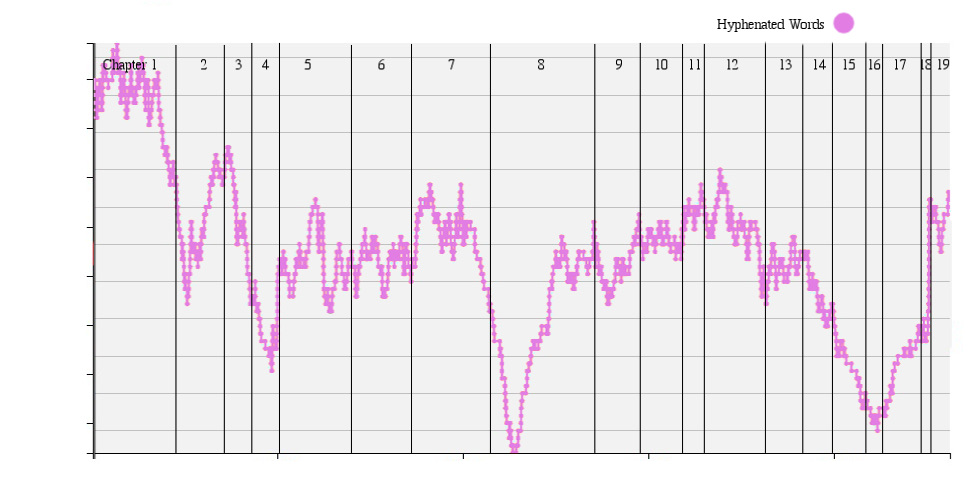
I nourish ideas about the different people Bilbo encountered in Middle Earth and the different languages those people spoke (although they may all have spoken Bilbo’s own language to him during the adventure there and back again).  I’ve mentioned a few times already that Tolkien uses a goodly number of hyphenated words which are not hyphenated in the OED (snow-peak, egg-question, check the Concordance for all 608 of them). Either they are separate words that he’s joined or compound words that he has separated.  He even had made compound words of ones which the OED says are separate words or hyphenated!  I thought of searching for these words to see if they show a particular region of Middle Earth which speaks a language that flexibly mooshes words together to express meaning more specifically.  Would the right word for that be agglutinative?

Well, it’s easy enough to search on hyphens (fear not, I took out the dashes).  I’m just going to leave this graph here for folks to nibble with their second breakfast.

Hyphenated Graph

I’m not sure what to make of it yet; my first approximation is that Westron, Bilbo’s native language, is the agglutinative one and that Mirkwood and the effects of dragon-sickness were both so depressing as to shock Bilbo out of his usual speech patterns.

Sound Play: So What?

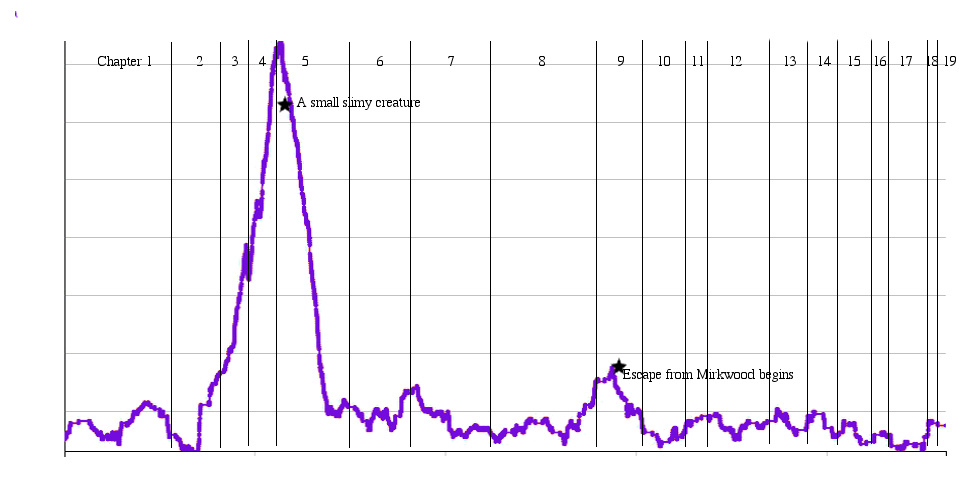
We observed previously that the sound words are fairly steady through the work with two peaks:

2015.07.09 Sound Only Graph

Chapter 9 Barrels Out Of Bond is full of grumbling, snoring, slapstick bumbling about, and sneezing – here are the thirty nine culprits which form that little peak: trotting clang bumped clank clink snored trotting bumped grunted racket thumped grumbling grumbling snoring bumping grumbled grumbled bump ho plump splash bump smacking thudding splash spluttering bumping creak bump dripping drippings sneezes snivel racket sneeze sneeze sneezed creaked grumbled.

Early on I entertained the idea that poetry was an indicator of high register.  Ahem.  One rousing chorus of [01.064] “Chip the glasses and crack the plates!” soon cured me of that, although I maintain that once Thorin declares himself, the register of the poetry rises, even including the reprise of Tra-la-la-lally.  I thought, “How can I measure poetical words within the prose?”  It’s too easy to cherry-pick one’s examples without a strict criterion, so I thought of onomatopoeia – poetry words that could be identified objectively.  Lucky for us, the OED marks words that are onomatopoetic – including echoic and imitative words – so I let those awesome editors make the human-yet-objective identifications for me.

Sound-play words became my measurement of poesy, and I abandoned all pretense of calling these words “high” register immediately, and of marking them either “low” or “high” very shortly after that.

In the end, it’s Chapter 5 which uses sound play words like the instruments of the London Symphony Orchestra.  After all, the chapter is not titled “Riddles in the Well Lit Parlour with Plenty of Visual Images”.

The exciting news for us is that we can measure exactly what Tolkien changed between his two editions of Chapter 5, and we know exactly why he made those changes.  We’ve proven that the new paragraphs were full of uncommon words, we’ve proven that those new paragraphs were full of sound words.  I believe we can conclude positively that the sounds of stagnant water and deep-throated swallowing and Gollum words and a preponderance of initial-S words are Tolkien’s specific instruments for creating the tone of decay and corruption which emanates from The Ring.  I would be excited to carry this idea forward to examine the ring-influenced portions of The Lord of the Rings.

So what?  So we have a tool – a robust and valid tool – for seeking the influence of the Ring, of corruption, of evil in Tolkien’s work at a subtler level.  It’s right there, encoded in the sounds of the words, waiting for us to discover.

footnote: alert Word Fans who hang on every graph will realize that this is a new version of the Sound graph made since the decision to count the names Gollum and Roäc and Carc as sound play words.  The scale goes up to 0.03 now to contain that Chapter 5 peak and even the Chapter 9 peak looks rather puny in comparison. For comparison, the overall uncommon words graph scale reaches to 0.070.  See the posts tagged 1937 to see with smaller windows even stronger influence of sound on Chapter 5.

Archaic Words: So What?

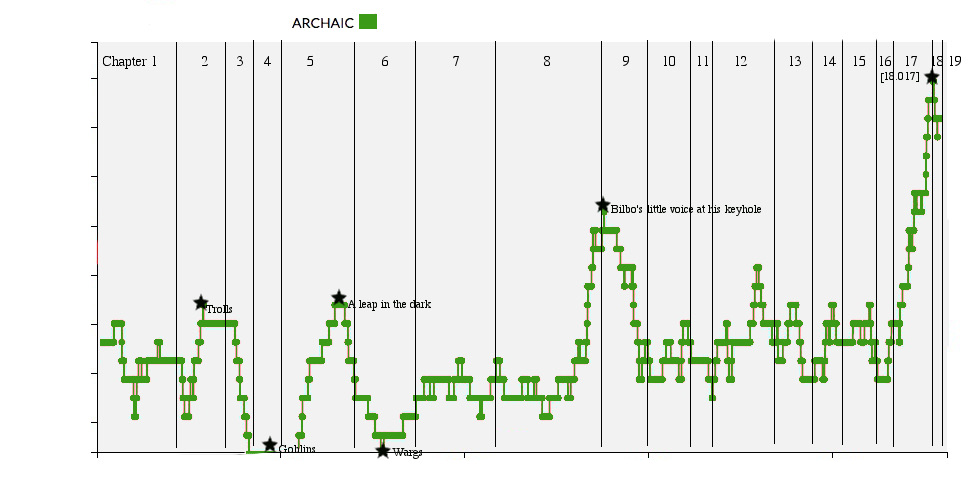
When we first considered the pattern of archaic words, I had decided ahead of time that these would indicate high register.  I think I’m going to have to let go of that for now.  Our green line of archaic words does indicate a general rise toward the rhetorical climax of the book.

Archaism with Words

But only 32 words out of 1534 uncommon ones – that’s 2% – qualify as archaic!  We simply don’t have robust findings, as the statistician part of my mind would say.

Let’s set aside the drive to prove something and have a look around.  We discussed earlier that archaic words signal elves in nearby scenes – a reminder that elves live much longer than hobbits.  Elves speaking the same tongue as Bilbo will have learned it centuries before he did and have a lovely old-fashioned diction in that hobbit’s opinion.  As we noted, however, it is the word “merry” which fills most of this trend.  Do thousands of years of life contribute to merriment?  Let us hope so.

When archaic words drop to nothing at all, those are goblin scenes.  Alert Word Fan Grace commented that “elf” and “goblin” may have been interchangeable words in literature before The Hobbit and that Tolkien probably tapped different parts of his vocabulary to express the huge contrast between the different peoples about whom he was writing.  Google’s Ngram viewer indicates through most of the nineteenth century that the two words were used at about the same rate, a suggestion that the words could have been used interchangeably, but before that the Norse-derived word “elf” had been strongly preferred in written English to the French-derived word “goblin”.

We also noted that the goblin scenes are bereft of food words as well – and that when food words are low, Tookishness trends upward!  It’s probably all to the good that Bilbo’s adventurous spirit rises when there are goblins about, now that I think of it.

Tolkien used a light touch with archaic words.  Compare his density of old forms with that of a writer who influenced him, William Morris who piles on real or invented strong past participles, thees and thous, kennings, and poetry in his work House of the Wolfings.  Tolkien enjoyed that story and then improved on the archaic techniques.  He never slowed us readers down by making us puzzle out his meaning.

I still have a drive to chase down archaic words, turns of phrase, and syntax; perhaps in The Lord of the Rings next.  I do admit that I spotted dozens of places in The Hobbit where I expected to see a subjunctive form and didn’t.  It’s a good thing the road goes ever on!

Morris, William. The House of the Wolfings. Project Gutenberg. Kindle Edition.

Everybody Wins!!

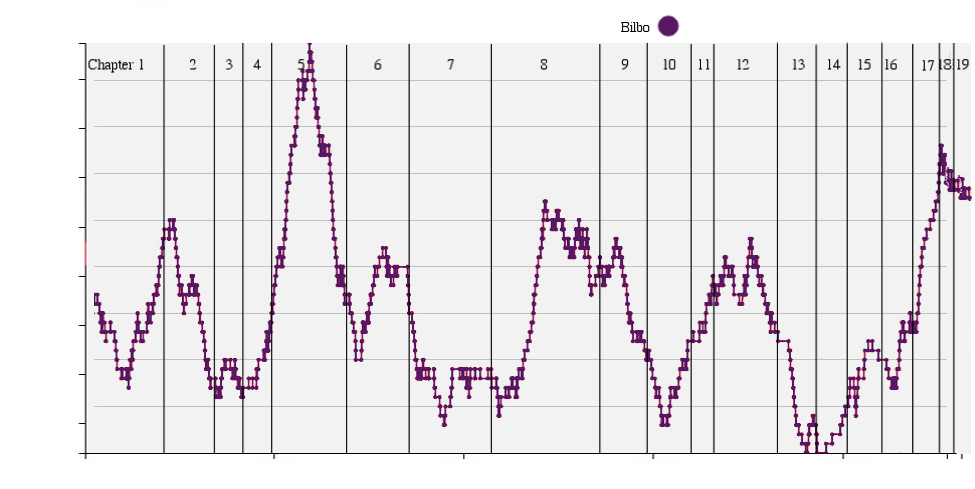
This is the graph under consideration:
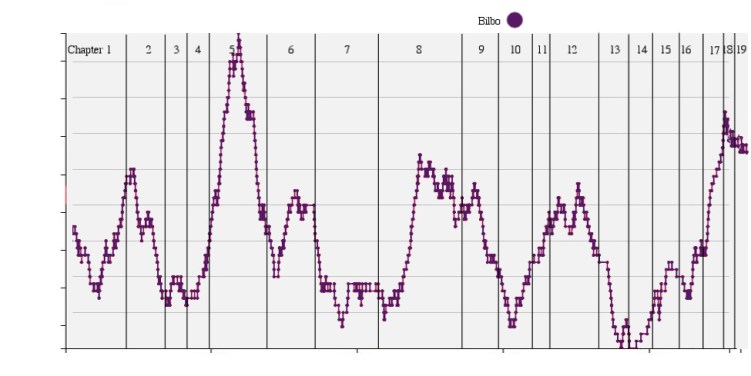
Bilbo

The Tolkien Professor has observed that Bilbo’s big crossroads are finding the ring, killing the spider, and going down the tunnel toward the dragon.  Each scene includes making an active choice to move forward in the dark.

[05.007]  ‘Go back? ‘ he thought.  ‘No good at all!  Go sideways?  Impossible!  Go forward?  Only thing to do!  On we go!’

Clearly these three choice points show up in our graph plus two more peaks – the end of Chapter 1 right before he runs out his front door without a pocket handkerchief, and the end of Chapter 17 (here we have run up against my unsteady hand copying the graph from Lexos in a flawed manner so that the chapter lines I drew don’t quite match up).  The words at that peak point are [17.062] “he had seen a sight that made his heart leap, dark shapes small yet majestic against the distant glow.”  Also, the Chapter 8 spider-killing peak extends into Chapter 9 and, although the Chapter 6 peak is overshadowed by the Chapter 5, there is one almost as large as the Chapter 12 and deserves mention!

Big thanks to Comfort & Food Guessers Kris, DMae, SonofSaradoc, Marie, Molly, SLMcAdie!

And Well Done Adventure & Challenge Guessers Dr Dmitra Fimi, Mattclen2, Repton, Tom Hillman, Galiodoc, Tom, SonofSaradoc!

And Shout-Out to Plot-Driven Guessers TriGirlJ, Tiberius, Ronan, Tom Hillman, Logan, Moxie, SonofSaradoc!

And the Winner is Kaypendragon!  The name “Bilbo” makes this graph!

Are you fascinated, too?  I hope that like me, you’re inspired to sift through the ends of Chapter 1 and ends of Chapter 17 as well as Barrels Out of Bond to see how they are related to Bilbo’s three big crossroads, or if we have a larger category here.  Do these six sections define the character even as his name identifies him?

Olsen, Corey. Exploring J.R.R. Tolkien’s The Hobbit. Boston: Houghton Mifflin Harcourt, 2012. Print.

Tolkien, J.R.R. The Annotated Hobbit.  Revised and expanded edition annotated by Douglas A. Anderson. Houghton Mifflin Company. Boston. Print.

A Most Fascinating Graph – and a Little Contest

Quick, Word Fans, without thinking too hard, name the scenes wherein Bilbo makes his greatest personal growth – makes his famous choices!  My picks are –

  • Chapter 5, Riddles in the Dark, when going forward is the only thing to do, his hand comes upon a ring, and he survives by his wits against a very disturbing adversary
  • Chapter 8, Flies and Spiders, when he draws and names his little sword and rescues his friends from spiders
  • Chapter 9, Barrels Out of Bond, when he plans and enacts a daring escape for himself and thirteen dwarves
  • Chapter 12, Inside Information, when he matches wits with a dragon!!
  • Chapter 16, A Thief in the Night, when he has wrestled his ethics into their proper order and saves his friend Thorin by betraying him

Well, I was noodling around with Lexos, as you do, and plugging in different words to see if they made a pretty pattern.  My picks up above do not quite match this new graph, but four out of six ain’t badBilbo

Here’s the contest: Of what one word in The Hobbit does this graph represent the frequency?

Update 2015.07.08 – this is the graph of the word “Bilbo” – congratulations KayPendragon!  I’ve added the word to the legend of the graph

The first correct answerer in the comments section will receive a custom made minisock – suitable for decorating holiday trees – in your choice of the scarlet-and-gold of the Signum University Eagles or the purple-and-silver of the Mythgard Institute Dragons.

A Few Special Words

We tagged a few other categories of words as we went along.  Remembering that while the Concordance has all 1534 uncommon words entered, I have only had chance to thoroughly examine and make special notes on the 300 which were the most interesting to me and seemed the most likely to be “archaic” or a “gem” or to fit the other ideas I was curious about.  In fact, if you search on the tag “brief”, you will find those words for which I only made a plain concordance entry.

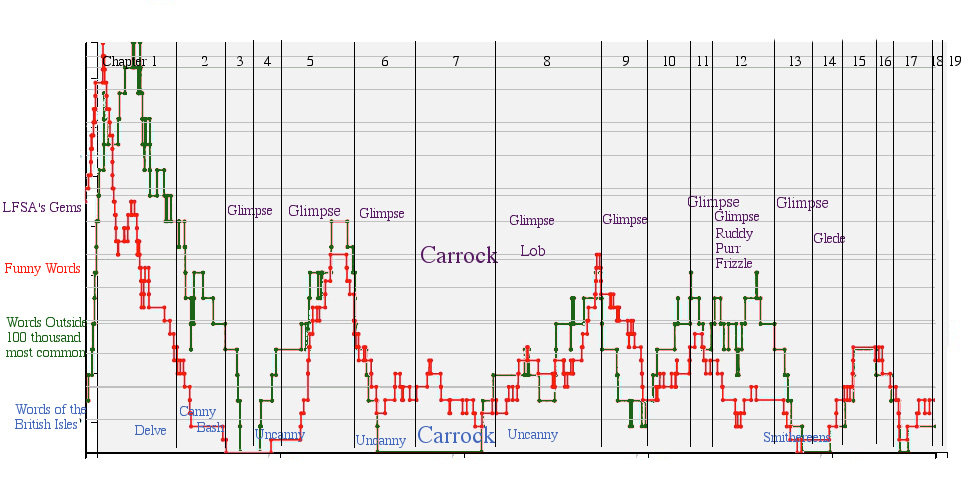
Meanwhile, those special other tags.  There are not many of them, so I concatenated them all onto one graphic for us:

Special Words

The few blue words are tagged “British” – from Scottish, Irish, and Cumbrian.  The green graph shows us the words from outside the most frequent hundred thousand words in the Project Gutenberg corpus, tagged 100K.   I also had a few thoroughly subjective tags.  The red graph shows us words I tagged “funny” (and a few which the OED calls “jocular”), and I’ve been told that my sense of humour is flawed.  For example, I think the word “quoits” sounds funny and that “burglar” is funny for being anti-heroic.  The few delightful plum words are my personal favorites with the “gem” tag (yes, the lovely Cumbrian word “carrock” is also one of my gems). They are the words which I discovered had multiple meanings and nuanced connotations which all contribute to Tolkien’s elegant storycraft.