A few weeks ago, we posted our discoveries about the pattern of food words in The Hobbit. You may recall our graph of uncommon food words (blue) superimposed on the graph of all uncommon words (red). We also remember that the two graphs are on different scales: the height of the blue line accounts for a portion of the height of the red line.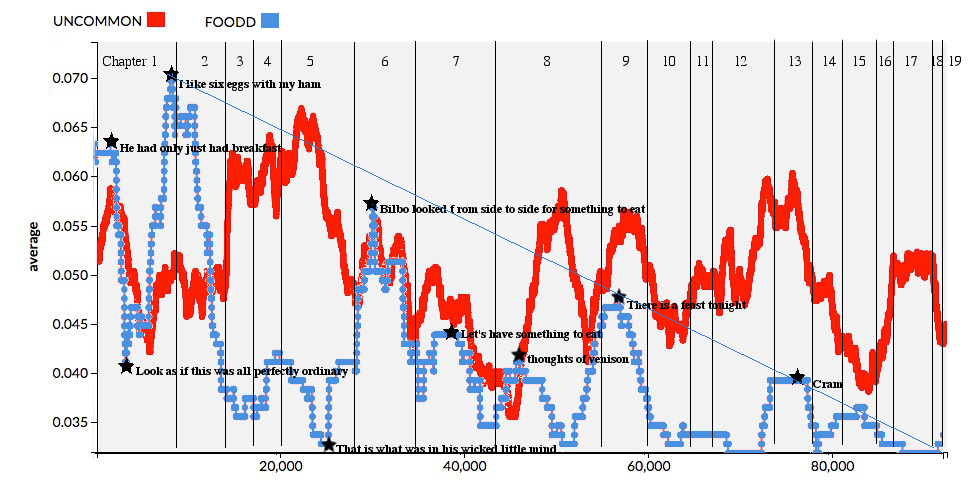
At the root of my scholarly curiosity lies my childlike question full of wonder, “How does he do that?” I suspect that the proper, serious phrasing is, “How does Tolkien achieve and manipulate register throughout the work?” I had a notion that Tolkien’s broad expressive vocabulary, developed both personally and professionally, provided numerous and powerful tools in his toolbox for creating high register. We eliminated the most common words from our consideration and set to work finding patterns in the uncommon words.
If I connect the stars at “six eggs” and Chapters 6, 9, and 13, I have found a lovely pattern of food words decreasing over the course of the work. We can observe Bilbo developing from a comfortable hobbit concerned with good things to eat into a more experienced and deep character, interested in and partaking of a world wider than breakfast-time, tea-time, and supper-time. We can also see the places – those stars we just linked – where the food words contribute most strongly to the pattern of uncommon words.
So what?
We see a pattern – and we choose to discuss data points which support an idea we already nourished. But what do we learn? Let’s look beyond that convenient and too-simple line. Bilbo “had only just had breakfast” in the first peak of food words in the first scene of the chapter. Then the food words decrease parallel to all uncommon words while Bilbo’s Took side begins to rouse. The food words reassert themselves by the end of Chapter 1 when “The Tookishness was wearing off.” [01.142]. Are food words a sign of Bagginsishness? The food words even come back more densely than they had been at first as Bilbo takes breakfast orders and bustles about the very proper and Bagginsish hospitable duties of finding beds and linens
[01.142] The Tookishness was wearing off, and he was not now quite so sure that he was going on any journey in the morning.
To make the graph between peaks fall, it takes both hunger and distraction from food words. It takes pleasant distraction in Chapter 3, fright and fight and flight in Chapter 4, focus and wits and luck in Chapter 5. But it takes more. As Chapter 3 begins, the food words plummet while the uncommon words soar steeply. It’s not a slow process but a liminal instant.
[03.006] “You are come to the very edge of the Wild,
Not many of us reading novels in our comfortable chairs have been truly hungry, nor have we been over the very edge of the Wild. Bilbo certainly has not. Across that edge, the narrative voice changes, expands its word-hoard not only speaking less frequently of food but drawing on a wider array of uncommon words to tell of more wonders.
After that long food-impoverished section in Chapters 3, 4, and 5, the food words and Bagginsishness never rise to the same heights. Mirkwood’s privations and spider-battles show a decrease in food words after which the food words rise again and again do not reach their former heights. Calling Chapter 12 a “distraction from food” sounds a bit fatuous, but the sight of Smaug and the ensuing battle of wits as well as Bilbo’s quite successful bit of burglary completely drive food words from the text. After that, empty crockery and cram are the meager sustenance; then war-time drives food back below even the rationing standards of England in the War.
Finally, we get to Chapter 19. I have suggested previously that Chapter 19 heals. Bilbo has made his way slowly home.
[18.051] He had many hardships and adventures before he got back. The Wild was still the Wild, and there were many other things in it in those days beside goblins; but he was well guided and well guarded – the wizard was with him, and Beorn for much of the way – and he was never in great danger again.
In the final chapter, elven song acknowledges the death and sadness of his adventure while offering up the idea that the green lands are waiting. He spies his Hill and the seeds of poetry that were quickened in the spider-taunting scene bear fruit.
[19.033] Gandalf looked at him. ‘My dear Bilbo!’ he said. ‘Something is the matter with you! You are not the hobbit that you were.’
Indeed, Bilbo – the author and therefore narrator of the story – has not mentioned uncommon food at all since “bacon” at the end of Chapter 16, even in his after-battle recovery. At the very end of the story – do you see that tiny uptick in the blue graph? – the kettle sings and the tobacco jar is shared. Bilbo is different – changed, but not broken. The food words will return, all the more savory.
Bilbo will recover from fear and war and inhuman enemies. We see it in the pattern of words just as clearly as we feel it. Resilience is inherent in being a hobbit, in valuing food and cheer and song above hoarded gold – and the tale took us there and back again.
 words that you were saying