Fruit

I’ve always been fascinated by the first use of “fruit” in The Hobbit, as a description of hobbit laughs. It gave me the impression of chuckling and full-bellied laughter.  The OED reveals a colloquial meaning for fruity as:

colloq. Full of rich or strong quality; highly interesting, attractive, or suggestive.

and thus the 01.004 use of fruit has earned the “archaic” tag.  I now can hear hobbit laughter quite clearly – rich and strong, interesting, attractive, suggestive.  Thanks, OED!

  • 01.004 and laugh deep fruity laughs
  • 07.126 nuts, flour, sealed jars of dried fruits,
  • 08.105 and dangle like ripe fruit)
  • 19.043 and fruit and feasting in autumn.

“fruity, adj.” OED Online. Oxford University Press, March 2016. Web. 10 March 2016.


Dine & Dinner

Before the middle of the book the concept of dining fades away.  Tolkien never writes “dining room” – it is always “dining-room” which also has its own entry as an uncommon word and for the delight of fans of the hyphen.

  • 01.002 kitchens, dining-rooms,
  • 01.004 (especially after dinner,
  • 01.012 Make you late for dinner!
  • 02.001 went into the dining-room.
  • 02.002 in the kitchen before turning out the dining-room.
  • 02.002 in the dining-room by the open window,
  • 04.012 in Bilbo’s dining-room that seemed so long ago,
  • 07.094 or a dinner,
  • 07.095 When dinner was over
  • 08.066 all about having a most gorgeous dinner.’

Kitchen

Coming around 3,000th most common of the words in Project Gutenberg, we begin close to the heart of Bag End, but Gollum knocks all thoughts of kitchens out of the story.  “Kitchen” is a word of Dutch and German heritage, but ultimately from the Latin verb coquere, to cook.

01.002 kitchens, dining rooms
01.059 and Dwalin at the door of the kitchen,
01.068 in the middle of the kitchen trying to see what they were doing.
02.001 in the kitchen.
02.002 in the kitchen before turning out the dining-room.
05.002 in his own kitchen at home –

“kitchen, n.” OED Online. Oxford University Press, March 2016. Web. 10 March 2016.

Eat

We begin in paragraph 01.001.  Please notice that “eats” in 05.028 is a sound-play use, “We eats it”, with Gollum adding an S where it’s not usually heard.

  • 01.001 with nothing in it to sit down on or to eat:
  • 01.051 for the late-comers to eat
  • 01.060 The dwarves ate
  • 01.060 and ate,
  • 01.123 to eat,
  • 02.032 He had eaten most,
  • 02.046 just to be et by you and Bert.
  • 02.046 You’ve et a village
  • 02.081 and eat them later –
  • 02.116 and looked fit to eat,
  • 03.001 and their horses had more to eat than they had;
  • 03.028 “Mind Bilbo doesn’t eat all the cakes!”
  • 04.024 For goblins eat horses
  • 05.022 whether he was good to eat,
  • 05.028 we eats it,
  • 05.029 that could save him from being eaten.
  • 05.031 the idea of eating was rather on his mind.
  • 05.034 who was still thinking uncomfortably about eating.
  • 05.047 and have not the danger of being eaten to disturb your thinking.
  • 06.039 for something to eat;
  • 06.039 and he ate three wild strawberries that he found on its bank,
  • 06.056 He’ll be eaten if we don’t do something,’
  • 06.068 for they did not eat such creatures)
  • 06.074 fry them, boil them and eat them hot?
  • 06.088 with next to nothing to eat,
  • 06.094 Bilbo was not going to be eaten after all.
  • 07.023 He does not eat them;
  • 07.023 neither does he hunt or eat wild animals.
  • 07.024 and then Bilbo felt so hungry that he would have eaten acorns,
  • 07.060 Killed, eaten, gone home?’
  • 07.090 Let’s have something to eat!’
  • 07.094 All the time they ate,
  • 07.112 moving off to find something to eat as quick as he could.
  • 07.116 he had eaten two whole loaves
  • 07.121 Not eaten up by Wargs or goblins or wicked bears yet I see’ ;
  • 07.126 and they were good to eat,
  • 07.126 will be wholesome to eat or to drink.
  • 07.129 Soon after midday they ate with Beorn for the last time,
  • 08.036 there was practically nothing left to eat or to drink.
  • 08.046 That night they ate their very last scraps
  • 08.048 When he heard that there was nothing to eat,
  • 08.048 and I could not count or describe the things there were to eat
  • 08.057 all the good things that were being eaten,
  • 08.058 they were eating
  • 08.083 Aye, they’ll make fine eating,
  • 08.104 to see which was the juiciest to eat.
  • 08.110 We will eat you
  • 08.125 if there had been anything to eat.
  • 09.061 in which it had eaten out a wide bay.
  • 10.014 I could eat anything
  • 12.060 Let me tell you I ate six ponies last night
  • 12.060 and eat all the others before long.
  • 12.062 that I can eat a dwarf-ridden pony
  • 12.072 and I have eaten his people like a wolf among sheep,
  • 13.001 Little they ate
  • 13.010 and then eat me,
  • 15.058 You may eat that,
  • 18.048 and eaten much of your bread.

Food Words: So What?

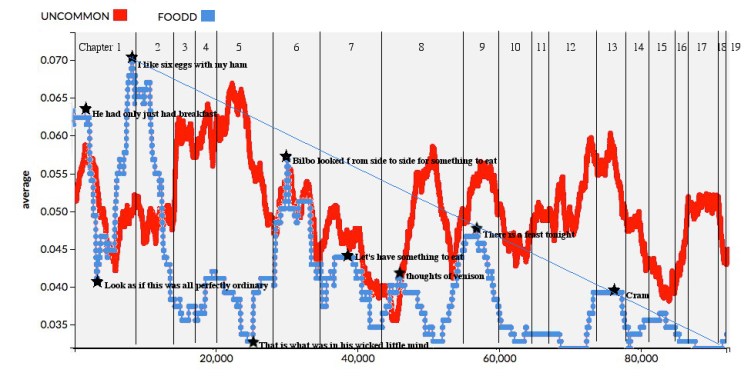
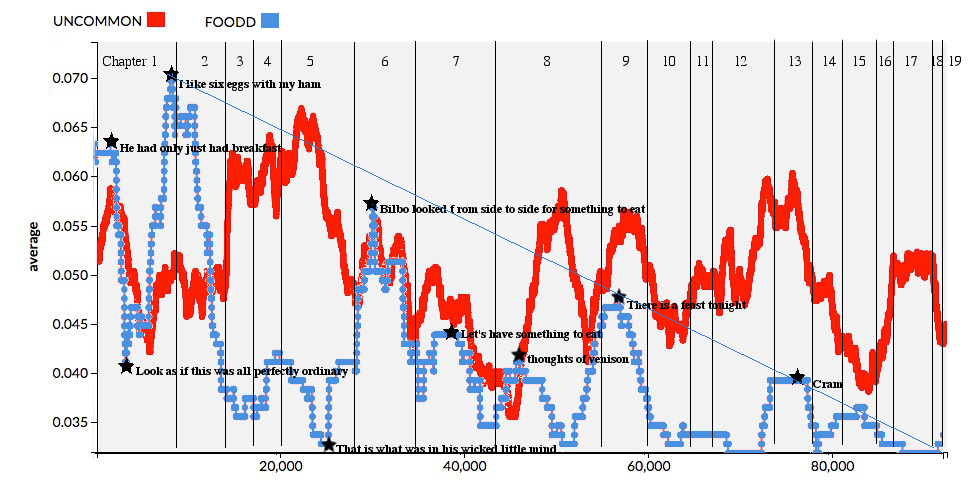
A few weeks ago, we posted our discoveries about the pattern of food words in The Hobbit.  You may recall our graph of uncommon food words (blue) superimposed on the graph of all uncommon words (red).  We also remember that the two graphs are on different scales: the height of the blue line accounts for a portion of the height of the red line.2015.07.02  Uncommon and Food with Food Line
At the root of my scholarly curiosity lies my childlike question full of wonder, “How does he do that?” I suspect that the proper, serious phrasing is, “How does Tolkien achieve and manipulate register throughout the work?”  I had a notion that Tolkien’s broad expressive vocabulary, developed both personally and professionally, provided numerous and powerful tools in his toolbox for creating high register.  We eliminated the most common words from our consideration and set to work finding patterns in the uncommon words.

If I connect the stars at “six eggs” and Chapters 6, 9, and 13, I have found a lovely pattern of food words decreasing over the course of the work.  We can observe Bilbo developing from a comfortable hobbit concerned with good things to eat into a more experienced and deep character, interested in and partaking of a world wider than breakfast-time, tea-time, and supper-time.  We can also see the places – those stars we just linked – where the food words contribute most strongly to the pattern of uncommon words.

So what?

We see a pattern – and we choose to discuss data points which support an idea we already nourished.  But what do we learn?  Let’s look beyond that convenient and too-simple line.  Bilbo “had only just had breakfast” in the first peak of food words in the first scene of the chapter.  Then the food words decrease parallel to all uncommon words while Bilbo’s Took side begins to rouse.  The food words reassert themselves by the end of Chapter 1 when “The Tookishness was wearing off.” [01.142].  Are food words a sign of Bagginsishness?  The food words even come back more densely than they had been at first as Bilbo takes breakfast orders and bustles about the very proper and Bagginsish hospitable duties of finding beds and linens

[01.142] The Tookishness was wearing off, and he was not now quite so sure that he was going on any journey in the morning.

To make the graph between peaks fall, it takes both hunger and distraction from food words.  It takes pleasant distraction in Chapter 3, fright and fight and flight in Chapter 4, focus and wits and luck in Chapter 5.  But it takes more.  As Chapter 3 begins, the food words plummet while the uncommon words soar steeply. It’s not a slow process but a liminal instant.

[03.006]  “You are come to the very edge of the Wild,

Not many of us reading novels in our comfortable chairs have been truly hungry, nor have we been over the very edge of the Wild.  Bilbo certainly has not.  Across that edge, the narrative voice changes, expands its word-hoard not only speaking less frequently of food but drawing on a wider array of uncommon words to tell of more wonders.

After that long food-impoverished section in Chapters 3, 4, and 5, the food words and Bagginsishness never rise to the same heights.  Mirkwood’s privations and spider-battles show a decrease in food words after which the food words rise again and again do not reach their former heights.  Calling Chapter 12 a “distraction from food” sounds a bit fatuous, but the sight of Smaug and the ensuing battle of wits as well as Bilbo’s quite successful bit of burglary completely drive food words from the text.  After that, empty crockery and cram are the meager sustenance; then war-time drives food back below even the rationing standards of England in the War.

Finally, we get to Chapter 19.  I have suggested previously that Chapter 19 heals.  Bilbo has made his way slowly home.

[18.051]  He had many hardships and adventures before he got back.  The Wild was still the Wild, and there were many other things in it in those days beside goblins; but he was well guided and well guarded – the wizard was with him, and Beorn for much of the way – and he was never in great danger again.

In the final chapter, elven song acknowledges the death and sadness of his adventure while offering up the idea that the green lands are waiting.  He spies his Hill and the seeds of poetry that were quickened in the spider-taunting scene bear fruit.

[19.033]  Gandalf looked at him.  ‘My dear Bilbo!’  he said.  ‘Something is the matter with you!  You are not the hobbit that you were.’

Indeed, Bilbo – the author and therefore narrator of the story – has not mentioned uncommon food at all since “bacon” at the end of Chapter 16, even in his after-battle recovery.  At the very end of the story – do you see that tiny uptick in the blue graph? – the kettle sings and the tobacco jar is shared.  Bilbo is different – changed, but not broken.  The food words will return, all the more savory.

Bilbo will recover from fear and war and inhuman enemies.  We see it in the pattern of words just as clearly as we feel it.  Resilience is inherent in being a hobbit, in valuing food and cheer and song above hoarded gold – and the tale took us there and back again.
A few more food words

In the course of entering all those plain concordance entries in the last week, I spotted a small handful of food words which had previously escaped notice.  Specifically, while I had decided to include words about food, a few such as “crock” escaped the first pass.  They’re all tagged and incorporated into our analyses now.  Simply click on “food” in the tags of this post to get a list of all the food words among the uncommon words.  Graphs are updated, too!  Don’t hesitate to post a recipe or comment.

Tobacco-jar

  • 19.048 and handed him the tobacco-jar.

Is it a food?  It is certainly a consumable, and in Hobbit culture, a comfort.  Note that Tolkien calls the herb “tobacco” in The Hobbit – a word which entered English in 1577.  In The Lord of the Rings, he calls it “pipeweed”, a compound word made at least as early as the 1500s from two words which we inherit directly from Old English.

Hyphenated in its sub-entry in OED under “tobacco”

“tobacco, n.” OED Online. Oxford University Press, March 2015. Web. 1 July 2015.

“pipe, v.” OED Online. Oxford University Press, March 2015. Web. 1 Juy 2015.

“weed, v.” OED Online. Oxford University Press, March 2015. Web. 1 Juy 2015.

Tea-time

  • 01.025 Just before tea-time
  • 01.098 here this Wednesday tea-time.’
  • 02.029 It was after tea-time;
  • 03.010 Tea-time had long gone by,

Remember, afternoon tea is a treat enjoyed by folks at leisure on comfortable sofas in midafternoon.  High tea is a working family’s meal sitting up high at the table in proper chairs, served right after getting home from work when one is famished, and including as much serious nutrition as possible!

This word is hyphenated just so in its OED sub-entry

“tea, n.” OED Online, Oxford University Press, June 2017, http://www.oed.com/view/Entry/198340. Accessed 21 September 2017.

Supper-time

  • 03.010 and it seemed supper-time would soon do the same.
  • 07.066 or it will be supper-time before it is ended.’

Supper-time, in a land with tea in the afternoon or early evening, is quite late indeed, well after dark in any case.

The dogs say it is a fantastical time about which many stories have been told and many ballads sung, but which does not come in truth.

The OED says, in contrast, that it can be hyphenated in the examples.

“supper time, n.” OED Online, Oxford University Press, June 2017, http://www.oed.com/view/Entry/194604. Accessed 21 September 2017.