Us

One of the most common words, but not as Gollum says it!  It’s a sound-play word which communicates both Gollum’s otherness and the echoey, huge, mysterious underground cavern.  This is one of the hisses that is the same in 1937 and 1951 – and in fact they occur in exactly the same phrase in the same numbered paragraph:

  • 05.059 It’s got to ask uss a quesstion,

The 1937 version is 1937.05.059.

Updated 2016.02.11

Gollum (sound)

Gollum is both a character and a sound that Bilbo hears down in the dark.  I’ve wrestled this name back and forth a few times – do I count the name as well as the throat sound in the onomatopoeia analysis?  There are clear reasons why or why not.  In the end, I did because simply repeating the character’s call-name contributes to the creepy, decaying, scary sound of Chapter 5.

These are instances of the sound in the throat, not the name.

  • 05.015 at least a tasty morsel it’d make us, gollum!’
  • 05.015 and when he said gollum
  • 05.080 Oh no! gollum!’
  • 05.093 gollum!
  • 05.093 gollum, gollum, gollum.’
  • 05.093 gollum, gollum, gollum.’
  • 05.093 gollum, gollum, gollum.’
  • 05.095 gollum.’
  • 05.111 It’s gone, gollum.’
  • 05.117 Ssss, sss, gollum!
  • 05.117 then goblinses will get it, gollum!
  • 05.117 never, gollum!
  • 05.117 gollum, gollum!’
  • 05.117 gollum, gollum!’

And here’s the name:

  • 05.012 lived old Gollum,
  • 05.012 He was Gollum –
  • 05.013 Actually Gollum lived on a slimy island of rock
  • 05.014 Gollum got into his boat
  • 05.014 Suddenly up came Gollum
  • 05.018 whispered Gollum
  • 05.020 said Gollum,
  • 05.022 Sssss’ said Gollum,
  • 05.022 and whether Gollum was really hungry.
  • 05.025 So Gollum hissed:
  • 05.031 and Gollum knew the answer as well as you do.
  • 05.036 Ss, ss, ss,’ said Gollum.
  • 05.036 Gollum brought up memories of ages
  • 05.039 Unfortunately for Gollum
  • 05.041 But it proved a nasty poser for Gollum.
  • 05.045 But suddenly Gollum remembered
  • 05.048 After a while Gollum began to hiss
  • 05.050 haste!’ said Gollum,
  • 05.052 Gollum was dreadfully disappointed;
  • 05.052 so that Gollum had to get back into his boat
  • 05.054 Gollum might have had some trouble guessing it,
  • 05.054 and Gollum soon gave it.
  • 05.056 Gollum began to get out of his boat.
  • 05.058 Gollum was disappointed once more;
  • 05.059 said Gollum.
  • 05.061 ask us!’ said Gollum.
  • 05.063 but Gollum thought it was a riddle,
  • 05.066 S-s-s-s-s,’ hissed Gollum.
  • 05.068 Handses!’ said Gollum.
  • 05.070 S-s-s-s-s,’ said Gollum
  • 05.073 Now Gollum was
  • 05.074 whether Gollum guessed right or not.
  • 05.076 shrieked Gollum,
  • 05.078 Gollum did not at once attack him.
  • 05.082 hissed Gollum.
  • 05.083 relieved to think of Gollum going away.
  • 05.083 What was Gollum talking about?
  • 05.083 Gollum did mean to come back.
  • 05.087 But who knows how Gollum came by that present,
  • 05.087 Gollum used to wear it at first,
  • 05.090 Gollum was cursing
  • 05.093 shrieked Gollum.
  • 05.094 Utterly miserable as Gollum sounded,
  • 05.094 and he had a feeling that anything Gollum wanted so much
  • 05.095 precious!’ Gollum answered.
  • 05.097 Never guessed!’ said Gollum.
  • 05.098 naturally, for Gollum had brooded for ages on this one thing,
  • 05.098 Gollum’s mind had jumped to a guess quicker than his;
  • 05.099 said Gollum.
  • 05.101 in Gollum’s mind,
  • 05.103 Gollum was
  • 05.103 in Gollum’s eyes had become a green fire,
  • 05.104 and that Gollum meant to murder him at any rate.
  • 05.105 and the splash as Gollum leapt from his boat.
  • 05.106 and saw Gollum’s eyes
  • 05.107 In a moment Gollum was on him.
  • 05.107 Gollum passed by,
  • 05.108 Gollum could see
  • 05.108 Gollum might lead him
  • 05.108 down to Gollum’s water.
  • 05.109 curse it!’ hissed Gollum.
  • 05.110 getting as close as he dared behind Gollum,
  • 05.112 Suddenly Gollum sat down
  • 05.112 After a while Gollum stopped weeping
  • 05.119 With a spring Gollum got up
  • 05.119 Gollum with his bright eyes had passed him by,
  • 05.120 Gollum flip-flapping ahead,
  • 05.120 Gollum began at once to count them.
  • 05.126 Gollum had brought Bilbo to the way out after all,
  • 05.126 There was Gollum sitting humped up right
  • 05.127 but Gollum stiffened at once,
  • 05.128 Gollum had no sword.
  • 05.128 Gollum had not actually threatened to kill him,
  • 05.129 Straight over Gollum’s head he jumped,
  • 05.130 Gollum threw himself backwards,
  • 05.130 He did not turn to see what Gollum was doing.
  • 05.130 Gollum was defeated.
  • 05.138 like an echo of Gollum’s misery,
  • 06.019 and shuddered most appreciatively at his description of Gollum.
  • 06.023 jumping over Gollum,
  • 08.125 in particular insisted on having the Gollum story,
  • 08.127 Gollum! Well I’m blest!

Egg

It’s not an uncommon word – but we include it because of how Gollum pronounces the plural!  It’s a sound-play word!

  • 05.045 teaching his grandmother to suck – ‘Eggses!’ he hissed.
  • 05.045 Eggses it is!’ Then he asked:

I look forward to the day when I can add all the eggs in the work, not just the uncommonly spelled ones.

2016.03.25 – and that happy day has come!  Eggs seems to be evenly distributed, as closely as such non-robust things can be.

  • 01.057 Put on a few eggs,
  • 01.141 I like six eggs with my ham,
  • 05.002 He thought of himself frying bacon and eggs
  • 08.074 and eggs
  • 15.014 since I came out of the egg,
  • 16.047 he was dreaming of eggs and bacon.

Creepsy

Tolkien added a -y to “creep” in parallel construction to “tricksy”.  The “-y” suffix indicates “characterized or full of” and in Old English was spelled “ig”.  “Creepsy” is Tolkien’s own original word constructed from his deep understanding of the roots of our language.  I’m giving it the onomatopoeia tag for adding an ‘s’ to Gollum’s words where there was none.

  • 05.117 and he’ll come creepsy

“-y, suffix1.” OED Online. Oxford University Press, June 2015. Web. 14 July 2015.

Bitsy

“Bitsy” is an adjective all by itself in the OED. The “-y” suffix indicates “characterized or full of” and in Old English was spelled “ig”. Tolkien uses it uniquely adverbially, replacing “for a bit”, constructed from his deep understanding of the roots of our language. I’m giving it the onomatopoeia tag for adding an ‘s’ to Gollum’s words where there was none.

  • 05.022 and chats with it a bitsy

“-y, suffix1.” OED Online. Oxford University Press, June 2015. Web. 14 July 2015.

“bitsy, adj.” OED Online. Oxford University Press, June 2015. Web. 14 July 2015.

Presenting: The Sound Play Words

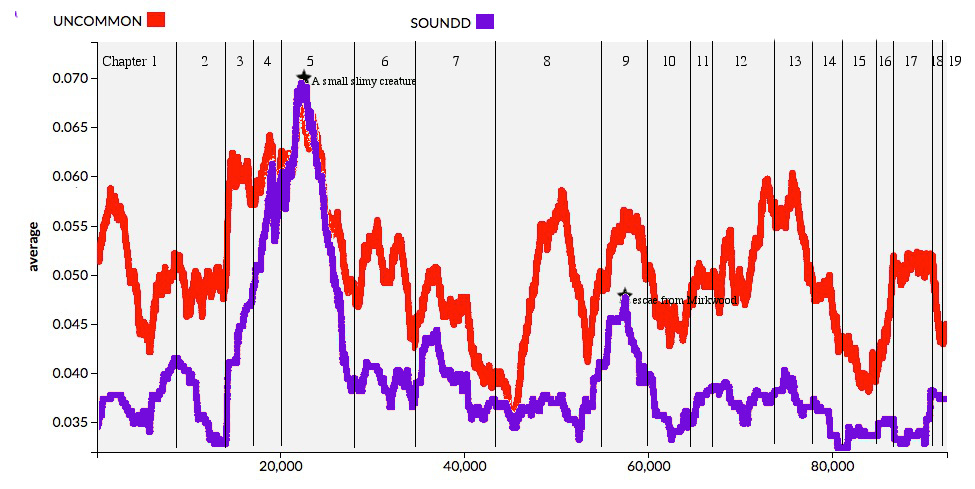
I had a thought that the words we tagged “onomatopoeia” would be steady throughout – they they are among the most-used tools in Tolkien’s kit.  Here they are, fairly steady, with two delicious peaks:

2015.06.15 Sound & Uncommon Graph

There’s Gollum!  His delicious sounds which follow that star in Chapter 5 and the goblins’ “Clap! Snap!” and battle sounds before it are the peak of the sound-imagery of the work.  Both here and at the local peak in Chapter 9 (which includes snoring, bumping, and grumbling), the uncommon sound words are so plentiful as to account for a good deal of those particular peaks in the uncommon word (red) line.

Preview of the Sound Play Words

Just a sneak peek as I prepare the whole graph.  Remember these are words labeled “onomatopoeic” or “echoic” or “imitative” by the OED plus the names “Gollum” and “Roäc” and “Carc”.

2015.06.15 Sound Only Graph

Before I erase it for the comparison graph, notice the y-axis!  Many more sound words than the others – the peak reaches right up to 0.02, half of all the uncommon words in the Chapter 1 low point and Chapter 19 denouement.

Goggle

The early meaning “to look at obliquely” has become a direct stare.  Even more interesting, OED suggests that goggle is an onomatopoeic word, expressive of oscillating movement.  Ahem.  Now we know what sound Gollum’s eyeballs make?

  • 08.114 and hundreds of angry spiders were goggling at them all round

“goggle, v.1.” OED Online. Oxford University Press, March 2015. Web. 1 June 2015.

Vocables

I learned many years ago from Professor Catriona Parsons that Gàidhlig waulking songs, the work songs which keep the rhythm for hand-fulling woolen cloth, are full of “vocables”.  In the first song in the linked video, the group’s words between the solo lines are vocables.

“These are not like fa-la-la,” she said. “They are very ancient sounds and they have meaning, but we have lost the meaning.”

She then taught us very carefully to pronounce these syllables, which usually alternate in the songs with phrases in current lexical use, just as she had heard them growing up on the Isle of Lewis.  I fancied that it did not matter if we knew the meaning, as long as those to whom we sang could understand.

Similarly, what’s up with tra-la-la-lally?  Corey Olsen, The Tolkien Professor, makes this point: ” tra-la-la-lally
here down in the valley!” [03.014] sounds very much like “tra-la-la-lally” is the name of the thing which is happening down in the valley.  These vocables are definitely sound play, only spoken by elves.  Do these sounds make those singers a bit alien?  Do they remind us that they speak other languages natively?  I believe they do.  In honor of the play of sound-on-sound in these vocables, I am giving them the ‘Onomatopoeia” tag.

  • 03.014 O! tra-la-la-lally
  • 03.015 O! tril-lil-lil-lolly
  • 19.002 Come! Tra-la-la-lally!
  • 19.003 O! Tra-la-la-lally
  • 19.004 Fa-la!
  • 19.004 Fa-la-la-lally
  • 19.004 With Tra-la-la-lally
  • 19.004 Tra-la-la-lally

I am separating out the Non-Lexical-Vocables after a bloody morning of trying to find a more suitable word. Haven’t found one yet, might have to ask my fellow scholar Jamie Stinnett.

  • 06.077 Ya hey!
  • 06.078 Ya hey!
  • 06.078 Ya harri-hey!
  • 06.078 Ya hoy!
  • 06.079 And with that Ya Hoy!