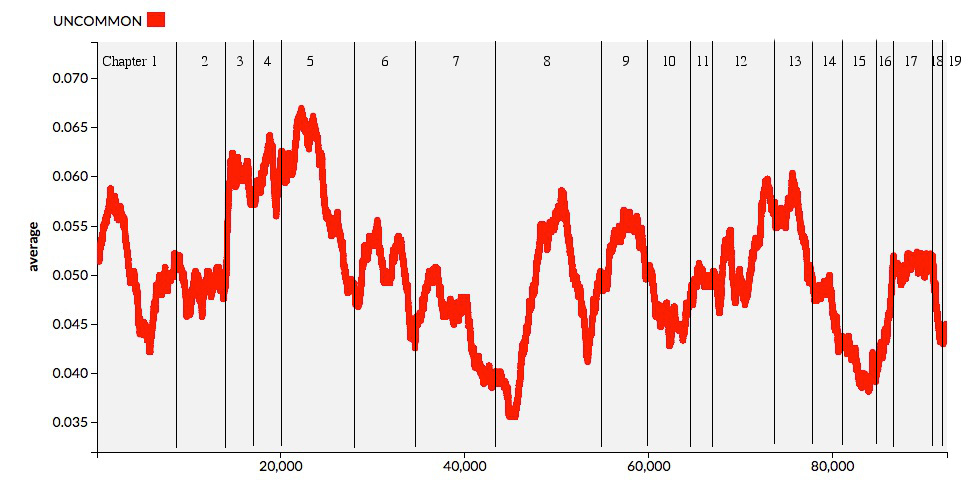
My goodness. The local dip in Chapter 1, around word 5700, is in fact one of the five or six lowest dips in the work. And what do we find there?
[01.096] ’Pardon me,’ he said, ‘if I have overheard words that you were saying.
Bilbo on his dignity.
My goodness. The local dip in Chapter 1, around word 5700, is in fact one of the five or six lowest dips in the work. And what do we find there?
[01.096] ’Pardon me,’ he said, ‘if I have overheard words that you were saying.
Bilbo on his dignity.
This first local peak occurs in Chapter 1, and we must remember what it represents: the five thousand words surrounding this point contain a peak number of uncommon words. Still it’s fun to see exactly what’s happening right at the peak:
So apt. This little peak comes at
[01.017]: You will notice already that Mr. Baggins was not quite so prosy as he liked to believe, also that he was very fond of flowers.
Yes, indeed, not prosy at all. Perhaps even given to using uncommon words like “snapdragon” or “laburnums of fire”. This five thousand word window looks in on plenty of uncommon words like “dwarves” and “dragon”.
You can see that this peak does not fall off immediately, the windows next to it contain “Far Over the Misty Mountains” at their edge.
It’s a beautiful sight!
I have used a window of five thousand words this time, which shows the trends much more smoothly. Let’s break this down and read what it is telling us in the next few posts. Remember our Words Per Chapter list as you look over the graph. The great news is that since I use Lexos directly on their web site, I can hover over any individual red dot and get the exact word number at the center of that window. Zipping over to my electronic copy of The Hobbit, I can find that word and report back.
Tech Support is going to try to teach me how to use image-manipulating software to make a layer of chapter break lines to superimpose on each of these graphs. If he succeeds, I will owe Tech Support a very big batch of blueberry muffins.
Were you enchanted by the word and number play of The Faerie Queen, too, Word Fans? I’m pleased to report that by word count, and including Chapter titles, the very middlemost word of The Hobbit is “creeping”.
[08.058] After a good deal of creeping and crawling they peered round the trunks and looked into a clearing where some trees had been felled and the ground levelled. There were many people there, elvish-looking folk, all dressed in green and brown and sitting on sawn rings of the felled trees in a great circle. There was a fire in their midst and there were torches fastened to some of the trees round about; but most splendid sight of all: they were eating and drinking and laughing merrily.
Pivotal moment? Yes, indeed!
To explore how to use the graphs created by Lexos, let’s supplement the great documentation on their web site focusing just on what we need for this project. Lexos looks at a rolling window, which means this: What if we said, “Looking for the word “IN”, looking in blocks of five words, where do we find our target word?
If we were standing in the book on the word “hole”, each block that contains that word (blocks 1, 2, and 3) would be considered and the number of instances averaged (2 instances, 1 instance, 1 instance, – average = 1.33). That’s a rolling average with a window of five, considered from the point of the word “hole”.
Oy. It is too much. I shall sum up with a picture. I asked Lexos to create a graph of the instances of “Gandalf” in the text with a window of 100 words.
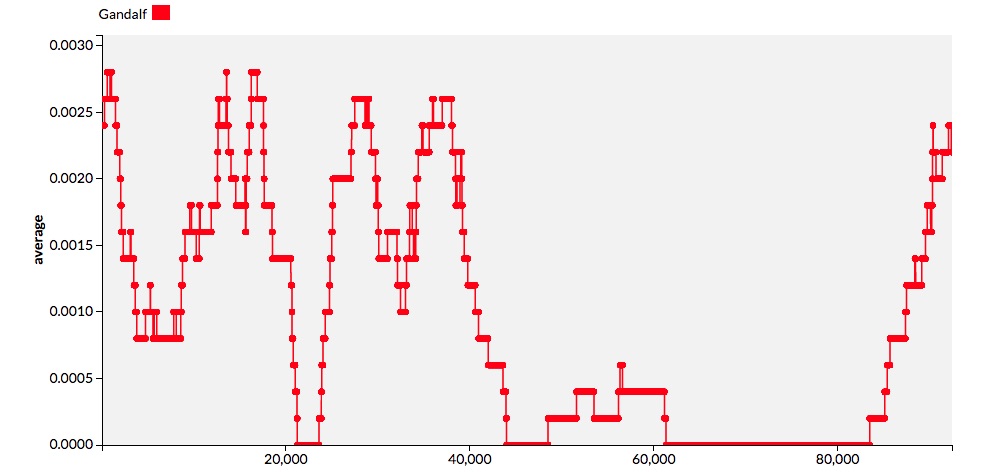
Those are word numbers along the x-bottom axis, which is why we made a word-number-to-chapter-break table in our previous post. See that gap around word number 44,000? That’s when he leaves Thorin & Company at the edge of Mirkwood! Those small spikes between 55,000 and 65,000 are three references to Gandalf, not descriptions of the wizard’s actions or words such as:
[09.031] ‘Upon my word!’ said Thorin, when Bilbo whispered to him to come out and join his friends, ‘Gandalf spoke true, as usual! A pretty fine burglar you make, it seems, when the time comes.”
Then at 85,000 Gandalf re-enters the action of the book! We can see the action of the book in the graphic! I’m so excited that there was a bit of jumping up and down here at Taigh Connlaich when I saw the first lovely picture! The gap in “Gandalfs” around word 21,000 is, of course, Chapter 5. Now that we know how to glean information from the Lexos graphs, hold on to your hats. Tomorrow, Word Fans, we will graph our categories of tagged words!
When we look at our graphs from Lexos, it’s going to be very useful to know where the Chapter breaks are in the stream of words. For curiosity, of course, I’ve also listed the number of words per chapter.
| Chapter | ends on word | Words in Chapter |
| One | 8,753 | 8,753 |
| Two | 14,029 | 5,276 |
| Three | 16,943 | 2,914 |
| Four | 21,024 | 4,081 |
| Five | 28,045 | 7,021 |
| Six | 34,801 | 6,756 |
| Seven | 43,874 | 9,073 |
| Eight | 54,127 | 10,253 |
| Nine | 59,986 | 5,859 |
| Ten | 63,946 | 3,960 |
| Eleven | 66,962 | 3,016 |
| Twelve | 74,141 | 7,179 |
| Thirteen | 78,082 | 3,941 |
| Fourteen | 81,334 | 3,252 |
| Fifteen | 84,716 | 3,382 |
| Sixteen | 86,876 | 2,160 |
| Seventeen | 90,836 | 3,960 |
| Eighteen | 93,662 | 2,826 |
| Nineteen | 96,154 | 2,492 |
 words that you were saying