Some Plain Concordance Entries

Word Fans, you yourselves can easily do the work of a concordance if you have an electronic copy of The Hobbit and a particular word in your head.  That’s why I have tried to jazz up the entries with some trivia, some etymology, some observations on the distribution of the particular word before we look at the distributions of grand classes of words.  What if you don’t happen to have an electronic copy?  Or what if you’d just like to stroll through the garden of lovely words and see what strikes your fancy?

My advisor, for example, looked at the Concordance page and said, “Manflesh?  I don’t recall the goblins referring to… (click).. Oh, of course!  The trolls!”  On his advice, although we are wending our way toward my finish date for the project and I won’t have time for thoughtful posts about every word, I’m going to try to make a classic brief concordance entry for each of them so you can look at the distributions.  Someday perhaps I’ll have time and encouragement to fill out these entries with thoughtful observations.

Tonight I’m going to enter all of Gollum’s sibilance words since we’ve been talking about them.  The sounds indicated by “ss” (up to five Ss) are already listed under “hiss”.

Another Proofreading Day

Today I ran through all the “Home” blog posts again for spelling, formatting, errors.  I had an inspiring and encouraging advisor meeting yesterday with The Tolkien Professor!  With all the exciting bits and pieces it’s easy to become scattered and his broad perspective helped me step back and get a better focus.  Let’s not lose sight of one very practical outcome: a working, useful concordance with helpful tidbits about each entry.

He has encouraged me to delve into our Lexos analyses – what makes that peak in uncommon words in Chapter 5?  We see it from the whole-book perspective and from the one-word-at a time perspective.  Now, can we name the classes of words which make it happen?  Our onomatopoeia words are a big driver – what else?

I’m looking forward to the journey.  For this evening, however, I think I’ve earned my cold chicken and pickles, porter, and seed-cakes.

Non-Intersection of 1937 and 1951

I’m still intrigued by the uncommon words which are only in the 1937 Chapter 5 and not the 1951 and vice-versa.  What else can we see?

  • 1937: 1811 words, 152 uncommon words, 8.4% uncommon words
  • 1951: 3571 words, 347 uncommon words, 9.7% uncommon words

So – about the same percentage of uncommon words, about 2.2 times as many in the newer as the elder.  Good.  Now, what about our special categories of words?

Food Words?

  • 1937 – none
  • 1951 – none – excellent, I’m down with 0 = 0.

Archaic words?

  • 1937: durstn’t – [1937.05.095]   “Here’s the passage,”  he whispered.  “It musst squeeze in and sneak down.  We durstn’t go with it,  my precious,  no we durstn’t, gollum!”
  • 1951: dursn’t  – [05.124]  He peered in, and shrank back. ‘But we dursn’t go in, precious, no we dursn’t.  Goblinses down there.  Lots of goblinses.  We smells them.  Ssss!’

One word in each edition, different spellings of the same word in the same spot in the story, although additions in 1951 give the paragraph a higher number.  Very well, then, I will continue to be intrigued by the disappearing T from “durstn’t” and call this “almost no change”.  By the way, “leapt” and “smelt” do not qualify as archaic, but I would like to give them a nice shout-out for being older, less-common forms, and in particular “leapt” for its strong-verb status.

What about sound play words?

  • 1937: croaking  flip-flap fuss spluttering squeeze
  • 1951: cracking flapped gurgling hiss hissed hissing screech shriek shrieked shrieking sniffed squeaked squeaker squeaking ssss

Five in ’37 to fifteen in ’51, all of those are called onomatopoeic or echoic or imitative by the OED.  Let’s add to that, shall we?  What about Gollum’s sibilance, which has made uncommon words out of some common ones?

  • 1951: creepsy eyeses goblinses guesses hates iss losst musst nassty pocketses  ssorry tricksy (“guesses” and “hates” qualify when gollum-wise-agreeing with “we” as the pronoun!)

Eleven more sound play words.  But not all the added Ss are mis-spoken by Gollum; some are spoken correctly by him and some are outside of direct speech.

  • cursing guesses noser nosey shambling sharpened sharper sheathed shiver shivering shriek shrieked shrieking side-passages slide slimy sloping smells smelt snag sneaking softer splayed squeezes stab stiffened swayed unlost

Twenty-eight new words with Ss, most of which begin with S.  My, my, my.

Once upon a time, I thought of tagging words which bespoke violence or danger, but that proved fruitless.

 ‘But you speak of him as if he was a friend. I thought Fangorn was dangerous.’

‘Dangerous!’ cried Gandalf. ‘And so am I, very dangerous: more dangerous than anything you will ever meet, unless you are brought alive before the seat of the Dark Lord. And Aragorn is dangerous, and Legolas is dangerous. You are beset with dangers, Gimli son of Glóin; for you are dangerous yourself, in your own fashion. Certainly the forest of Fangorn is perilous…’

However, as an exercise, I would like to point out how many of the non-intersecting 1937 vs 1951 words speak to me of peril or just makes the hair on the back of my neck stand up?

  • 1937 – recklessly slipping
  • 1951 –  blindly blood-curdling bowstring  crawling creepsy crouched cursing gnaw goblin-imp goblinses groping gurgling hates  hiss hissed hissing jagged maddened menacing menacingly nassty noser nosey orcs palely pang panted pinch  screech shambling sharpened sharper sheathed shiver shivering shriek shrieked shrieking slimy smells smelt snag sneaking sniffed splayed squeaked squeaker squeaking squeezes stab stiffened swayed tense tricksy tripping tunnels unmarked

Alert readers may notice that some words like “slimy” are listed as non-intersecting although they can be found in both versions.  Remember that we analyzed only those paragraphs which differ.  “Slimy” is found in paragraphs 11 and 13 in both versions and is added to paragraph 12 and 77 in descriptions of Gollum.

“crack, v.” OED Online. Oxford University Press, June 2015. Web. 19 June 2015.

“fuss, n.2.” OED Online. Oxford University Press, June 2015. Web. 19 June 2015.

“leap, v.” OED Online. Oxford University Press, June 2015. Web. 19 June 2015.

“smell, v.” OED Online. Oxford University Press, June 2015. Web. 19 June 2015.

Tolkien, J.R.R. (2012-02-15). The Lord of the Rings: One Volume (p. 499). Houghton Mifflin Harcourt. Kindle Edition.

footnote: there’s a word for the hair on one’s skin standing up – horripilation.  I didn’t want to put cool jargon in the the way of comprehension, but wanted to be sure my Word Fans have this delightful word in their back pocketses!
1937 words

Only an observation today to satisfy our curiosity.  Details and conclusions and error-checking will come in the weeks ahead.  These words appear in the 1937 Chapter 5 of The Hobbit and do not appear in the 1951 edition, the one with which we are most familiar:

croaking   daresay   durstn’t   findings   flip-flap   funnily   fuss   good-bye   jags   politely   recklessly   shuddered   slipping   sneak   sometime   spluttering   squeeze   unsuspecting

My goodness!  “Funnily” and “good-bye” and “politely”!  what a different feeling.  Here follow those words which were added in our 1951 edition.  I have included links for those which have entries in the Concordance or other posts:

back-door   backwards   Baggins   betterment   birthday-present   blindly   blood-curdling   bowstring   brooded   cracking   crawling   creepsy   crouched   cursing   dursn’t   eyeses   flapped   flattened   forefinger   galled   gleamed   gnaw   goblin-imp   goblinses   groping   guesses   gurgling   hates   hiding-place   hiss   hissed   hissing   humped   iss   jagged   leapt   losst   maddened   menacing   menacingly   mouse   musst   nassty   noser   nosey   oddments   orcs   paddling   palely   pang   panted   peered   pinch   pocketses   pouch   pricked   quicker   screech   shambling   sharpened   sharper   sheathed   shiver   shivering   shriek   shrieked   shrieking   side-passages   slide   slimy   sloping   smells   smelt   snag   sneaking   sniffed   softer   splayed   squeaked   squeaker   squeaking   squeezes   ssorry   ssss   stab   stiffened   swayed   tense   tricksy   tripping   tunnel-wall   tunnels   unlost   unmarked

Please do note that both editions have “ss”, “sss”, and “sssss” in them – it’s just four esses, “ssss” which is unique to the 1951.  So many things to say about these words, but I had better save it for another day, in the morning after coffee when I’m fresh.

Dare

Today’s tidbit is that the 1937 Hobbit has “durstn’t”  and the 1951 has “dursn’t“. I am not finding any reference at all on the negative contraction, but “durst” is given as the current past form, alongside “dared”.  Google’s Ngram Viewer tells us that both “durstn’t” and “dursn’t” fist appear in their corpus in the early 1800s, at first about equal in frequency but by 1925, “dursn’t” about twice as frequent as “durstn’t”.  “Did not dare” overwhelms these forms by an order of magnitude, and is a much older phrase than these contractions are.  Present forms “dassn’t” and “dare not” are more common than all those others, the latter much more popular of the two.

See more our earlier discussion of Gollum’s speech.

“Dare” is uncommon as are the contractions.

  • 05.124 ‘But we dursn’t go in
  • 05.124 no we dursn’t.

“dare, v.1.” OED Online. Oxford University Press, June 2015. Web. 18 June 2015.

Paragraph Comparison of 1937 with 1951

To begin, I’m happy to share my list of the 1937 and 1951 paragraphs – which ones match identically, which ones are close, which ones are unique to their edition.

Paragraph Comparisons 1937 & 1951

I won’t analyze the entire chapters, as there is so much overlap, and I’m excited about the differences.  Removing the identical paragraphs, we will examine:

1937: 29 paragraphs, 1811 words, 152 uncommon words

1951: 66 paragraphs, 3571 words, 347 uncommon words

A Little Time-Travel Through Chapter Five

I plan to spend the rest of today exploring differences in word use between Chapter 5 of The Hobbit as we all know and love it and Chapter 5 as it was published in 1937.  At that time, Tolkien didn’t conceive of Gollum’s ring as anything other than a small magical ring with invisibility powers.  Once he began work on The Lord of the Rings, however, he knew the ring to be far more.  He rewrote Chapter 5 and managed to get the whole book re-published.

‘Very well,’ said Bilbo. ‘I will do as you bid. But I will now tell the true story, and if some here have heard me tell it otherwise’ – he looked sidelong at Glóin – ‘I ask them to forget it and forgive me. I only wished to claim the treasure as my very own in those days, and to be rid of the name of thief that was put on me. But perhaps I understand things a little better now. Anyway, this is what happened.’

What we begin with:

1931 1951
Paragraphs 111 145
Words 5258 7,021

I’ll report back  in with the list of which paragraphs are identical as well as the number of uncommon words in each chapter soon, Word Fans.

Tolkien, J.R.R. (2012-02-15). The Lord of the Rings: One Volume (p. 249). Houghton Mifflin Harcourt. Kindle Edition.

Hunger and Archaism

Word fans, did you see what I saw?

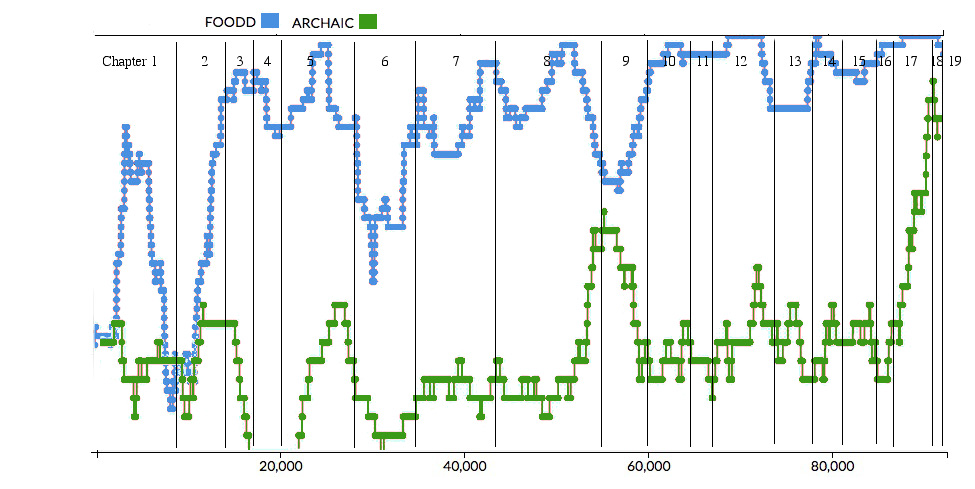
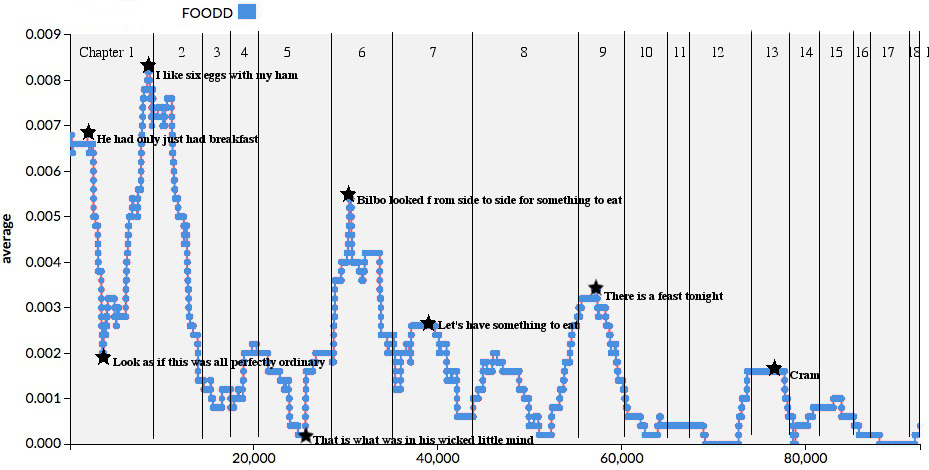
The food words generally decrease over the course of the book.  We predicted that.    If we read the dip in Chapter 1 as an abundance of common food words and the spike in chapter 6 as a spike in thinking about food they weren’t getting, it’s a trend.

2015.07.01 Food Word Graph with words

Then there was the archaic word graph, which broadly rises.

2015.06.17 Archaism Alone

What if we were to flip over the food word graph?  I suppose we could call it a hunger graph.

2015.07.02  Flipped Food

And then if we put those graphs on top of one another…

2015.07.02  Flipped Food and Archaism

We could, if we squint hard, call those matching trajectories.  If you had asked me last week if I had a prediction about this, I would probably have said, “Sure, as food and comfort go down across the book, archaism and lofty things increase, I’ll put a nickel on that.”  What piques my curiosity this morning?  Where and why these lines diverge from the predicted pattern.

Chapter 1?  I believe that’s a straightforward “many food words here are common” phenomenon and that the beginning and end of the chapter are my guides for where to think of the blue line.

Chapter 4?  Oh, yes.  Goblins.  No archaic words at all.  All current-use.  And food?  No.  Goblins do not serve tea.  Or supper.  Or even cram.  Modern words, no manners.  Uncouth, uncultured, ignorant.

Chapter 6 I chalk up to another measurement anomaly – the blue line shows us words about foods which the company is not eating.

But oh, yes, the beginning of Chapter 9.  Archaic words and food (remember, the blue line going down means hunger goes away).  Bilbo embraced being a hero and we enter Thranduil’s realm.  Spiders talked about food, elves treated their prisoners humanely.  In fact,

[08.144] … They gave [Thorin] food and drink, plenty of both, if not very fine; for Wood-elves were not goblins, and were reasonably well-behaved even to their worst enemies,

Goblins are the contrast to elves? Many scholars more learned than I have held forth on this topic.  I present this little lexomic morsel to nourish the discussion.

Presenting: The Sound Play Words

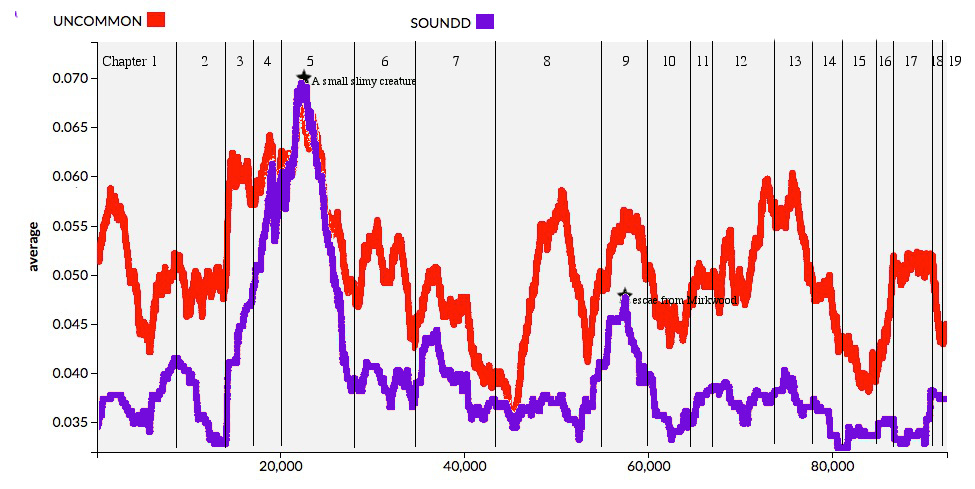
I had a thought that the words we tagged “onomatopoeia” would be steady throughout – they they are among the most-used tools in Tolkien’s kit.  Here they are, fairly steady, with two delicious peaks:

2015.06.15 Sound & Uncommon Graph

There’s Gollum!  His delicious sounds which follow that star in Chapter 5 and the goblins’ “Clap! Snap!” and battle sounds before it are the peak of the sound-imagery of the work.  Both here and at the local peak in Chapter 9 (which includes snoring, bumping, and grumbling), the uncommon sound words are so plentiful as to account for a good deal of those particular peaks in the uncommon word (red) line.

Preview of the Sound Play Words

Just a sneak peek as I prepare the whole graph.  Remember these are words labeled “onomatopoeic” or “echoic” or “imitative” by the OED plus the names “Gollum” and “Roäc” and “Carc”.

2015.06.15 Sound Only Graph

Before I erase it for the comparison graph, notice the y-axis!  Many more sound words than the others – the peak reaches right up to 0.02, half of all the uncommon words in the Chapter 1 low point and Chapter 19 denouement.