Paragraph Comparison of 1937 with 1951

To begin, I’m happy to share my list of the 1937 and 1951 paragraphs – which ones match identically, which ones are close, which ones are unique to their edition.

Paragraph Comparisons 1937 & 1951

I won’t analyze the entire chapters, as there is so much overlap, and I’m excited about the differences.  Removing the identical paragraphs, we will examine:

1937: 29 paragraphs, 1811 words, 152 uncommon words

1951: 66 paragraphs, 3571 words, 347 uncommon words

A Little Time-Travel Through Chapter Five

I plan to spend the rest of today exploring differences in word use between Chapter 5 of The Hobbit as we all know and love it and Chapter 5 as it was published in 1937.  At that time, Tolkien didn’t conceive of Gollum’s ring as anything other than a small magical ring with invisibility powers.  Once he began work on The Lord of the Rings, however, he knew the ring to be far more.  He rewrote Chapter 5 and managed to get the whole book re-published.

‘Very well,’ said Bilbo. ‘I will do as you bid. But I will now tell the true story, and if some here have heard me tell it otherwise’ – he looked sidelong at Glóin – ‘I ask them to forget it and forgive me. I only wished to claim the treasure as my very own in those days, and to be rid of the name of thief that was put on me. But perhaps I understand things a little better now. Anyway, this is what happened.’

What we begin with:

1931 1951
Paragraphs 111 145
Words 5258 7,021

I’ll report back  in with the list of which paragraphs are identical as well as the number of uncommon words in each chapter soon, Word Fans.

Tolkien, J.R.R. (2012-02-15). The Lord of the Rings: One Volume (p. 249). Houghton Mifflin Harcourt. Kindle Edition.

Hunger and Archaism

Word fans, did you see what I saw?

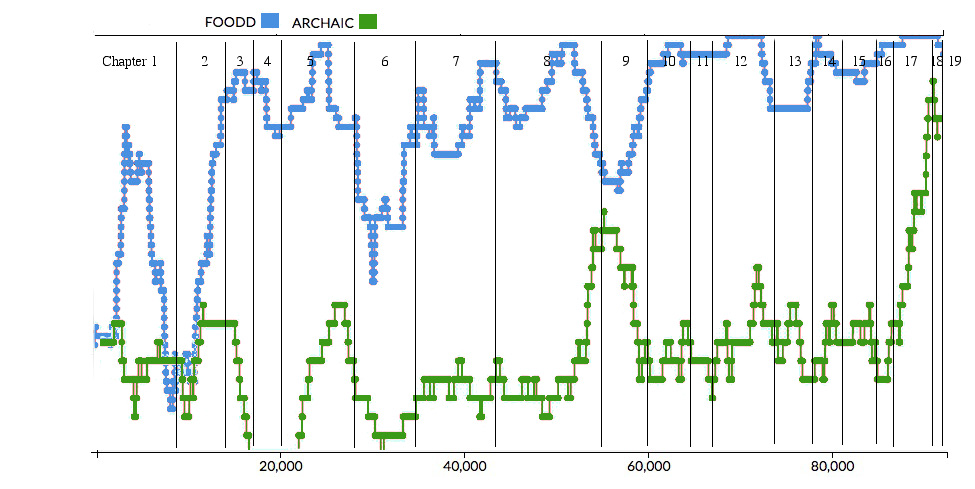
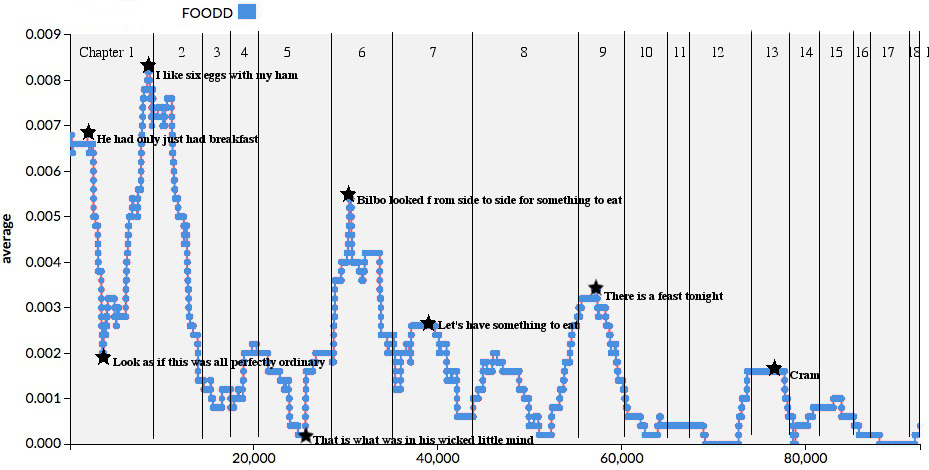
The food words generally decrease over the course of the book.  We predicted that.    If we read the dip in Chapter 1 as an abundance of common food words and the spike in chapter 6 as a spike in thinking about food they weren’t getting, it’s a trend.

2015.07.01 Food Word Graph with words

Then there was the archaic word graph, which broadly rises.

2015.06.17 Archaism Alone

What if we were to flip over the food word graph?  I suppose we could call it a hunger graph.

2015.07.02  Flipped Food

And then if we put those graphs on top of one another…

2015.07.02  Flipped Food and Archaism

We could, if we squint hard, call those matching trajectories.  If you had asked me last week if I had a prediction about this, I would probably have said, “Sure, as food and comfort go down across the book, archaism and lofty things increase, I’ll put a nickel on that.”  What piques my curiosity this morning?  Where and why these lines diverge from the predicted pattern.

Chapter 1?  I believe that’s a straightforward “many food words here are common” phenomenon and that the beginning and end of the chapter are my guides for where to think of the blue line.

Chapter 4?  Oh, yes.  Goblins.  No archaic words at all.  All current-use.  And food?  No.  Goblins do not serve tea.  Or supper.  Or even cram.  Modern words, no manners.  Uncouth, uncultured, ignorant.

Chapter 6 I chalk up to another measurement anomaly – the blue line shows us words about foods which the company is not eating.

But oh, yes, the beginning of Chapter 9.  Archaic words and food (remember, the blue line going down means hunger goes away).  Bilbo embraced being a hero and we enter Thranduil’s realm.  Spiders talked about food, elves treated their prisoners humanely.  In fact,

[08.144] … They gave [Thorin] food and drink, plenty of both, if not very fine; for Wood-elves were not goblins, and were reasonably well-behaved even to their worst enemies,

Goblins are the contrast to elves? Many scholars more learned than I have held forth on this topic.  I present this little lexomic morsel to nourish the discussion.
Presenting: The Sound Play Words

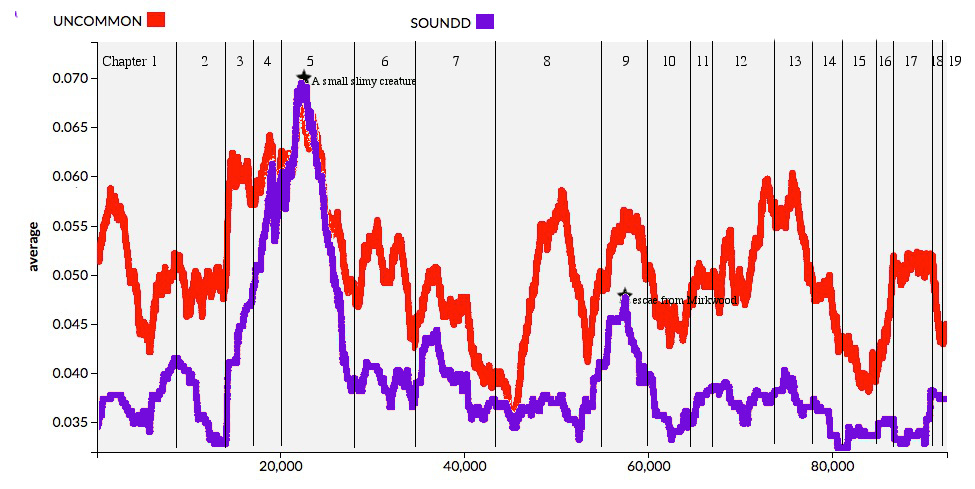
I had a thought that the words we tagged “onomatopoeia” would be steady throughout – they they are among the most-used tools in Tolkien’s kit.  Here they are, fairly steady, with two delicious peaks:

2015.06.15 Sound & Uncommon Graph

There’s Gollum!  His delicious sounds which follow that star in Chapter 5 and the goblins’ “Clap! Snap!” and battle sounds before it are the peak of the sound-imagery of the work.  Both here and at the local peak in Chapter 9 (which includes snoring, bumping, and grumbling), the uncommon sound words are so plentiful as to account for a good deal of those particular peaks in the uncommon word (red) line.

Preview of the Sound Play Words

Just a sneak peek as I prepare the whole graph.  Remember these are words labeled “onomatopoeic” or “echoic” or “imitative” by the OED plus the names “Gollum” and “Roäc” and “Carc”.

2015.06.15 Sound Only Graph

Before I erase it for the comparison graph, notice the y-axis!  Many more sound words than the others – the peak reaches right up to 0.02, half of all the uncommon words in the Chapter 1 low point and Chapter 19 denouement.

Presenting: the Archaic Words

Next we take a look at the words we tagged “archaic”.  You’ll recall that we used this tag for any word labeled “obsolete” or “archaic” or “rare” or “regional” by the OED.

2015.06.15 Archaic & Uncommon Graph

Our first little peak occurs in the troll scene.  Hmm.  In that scene we have “canny” and “booby” tagged “archaic”, but that’s all.  Shall we think of this region as right between the Tra-la-la-lally elves and Rivendell?  It might be best if we do.

Low points for  goblins and wargs, I’m pleased to see, and a high point for the game of great antiquity!  I like that we have a peak once in the Elvenking’s halls, and am delighted that the exact phrase is at the start of the daring rescue.  Aside from Thranduil’s caverns, the incidence of archaic words grows simply from wargs through the climax at [18.017].  What are those particular words?

[18.017] ‘Farewell, good thief,’ he said. ‘I go now to the halls of waiting to sit beside my fathers, until the world is renewed. Since I leave now all gold and silver, and go where it is of little worth, I wish to part in friendship from you, and I would take back my words and deeds at the Gate.’
[18.018] Bilbo knelt on one knee filled with sorrow. ‘Farewell, King under the Mountain!’ he said. ‘This is a bitter adventure, if it must end so; and not a mountain of gold can amend it. Yet I am glad that I have shared in your perils – that has been more than any Baggins deserves.’
[18.019] ‘No!’ said Thorin. ‘There is more in you of good than you know, child of the kindly West. Some courage and some wisdom, blended in measure. If more of us valued food and cheer and song above hoarded gold, it would be a merrier world. But sad or merry, I must leave it now. Farewell!’

The only “archaic” tagged words in this passage are “merrier” and “merry”, and they qualified only under the technicalities of obsolete meanings of “enjoyable”. While the passage does not hold much in the way of archaisms, archaic words surround the passage like a chalice lifting it up – to be read carefully, sipped delicately, never forgotten.

Patterns in the Food Words

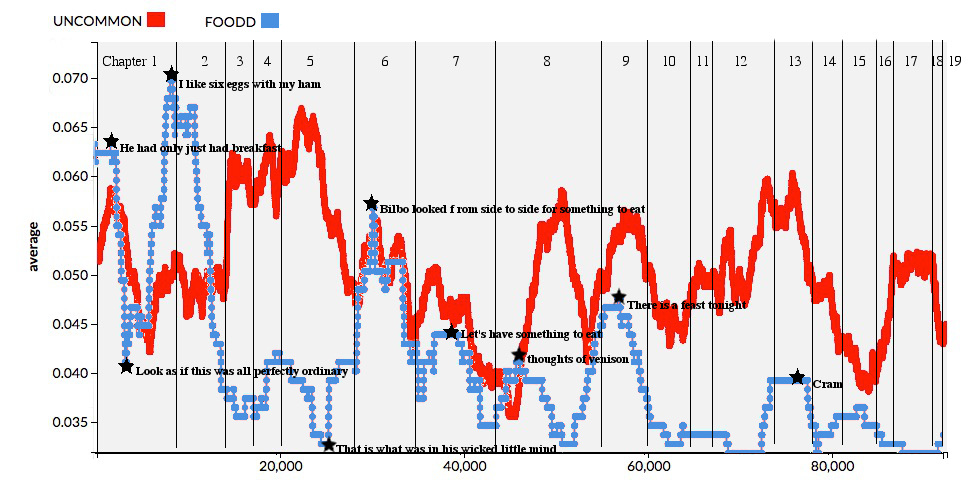
The region of densest Food words comes, as any of us might have predicted, in Chapter 1: The Unexpected Party.

2015.07.02 Uncommon with Food

The unexpected dip in Chapter 1 comes just as the dwarves begin to help with the washing up.  Remember that there are plenty of food words from among our favorite and most-used vocabulary which are not tagged in this analysis – like chicken.   This dip graphically reminds us that we are only looking at a rolling average, not at the point itself.

The end of the Unexpected Party, with its orders for breakfast, contains the highest uncommon food average in the book  – and the beginning of the next chapter continues the trend: trolls have much to say about food (mutton, manflesh).  Bilbo’s not even thinking about food in Riddles in the Dark, of course, and chapter 6 is mostly about the lack of food and the presence only of tiny scrubby herbs.

[06.039] As they went on Bilbo looked from side to side for something to eat; but the blackberries were still only in flower, and of course there were no nuts, not even hawthorn-berries. He nibbled a bit of sorrel, and he drank from a small mountain-stream that crossed the path, and he ate three wild strawberries that he found on its bank, but it was not much good.

After that?  Not much food.  I’ve noted the relief at Beorn’s home, in the deer-shooting scene of Mirkwood, and before the Wood-elves’ feast.  Perhaps the discussion of “cram” is not so much a relief as dry, and possibly tasteless, fact.

(update 2015.07.02)

Presenting the Food Words

There are many fewer uncommon food words than simply uncommon words, therefore our graph is more granular, but the data were analyzed in the same manner, with a rolling average across a window of five thousand words.

2015.07.01 Food Word Graph with words

Our y-scale – average number of food words – is much smaller than the scale for the uncommon words.  It doesn’t even reach 0.01, and we talked about all common words being around 0.04 in Chapter 1.  Clearly if we scrunched the food words down to the same scale as all the uncommon words, we would barely notice their line.  So that we can see variation in food words, we’ll keep the graph at the same size as we superimpose it on the overall uncommon words.

To find my list of food words, just follow the “food” tag or click here.

I know for a fact the chicken and apples are in the Ten Thousand most common words – I challenge my fellow scholars to tag and analyze all the food words of The Hobbit!

Leveling up the presentation

Great news, Word Fans, Tech Support has just downloaded an image-manipulating software for me and given me a basic lesson.  I will spend the afternoon learning how to make labeled graphs for you!

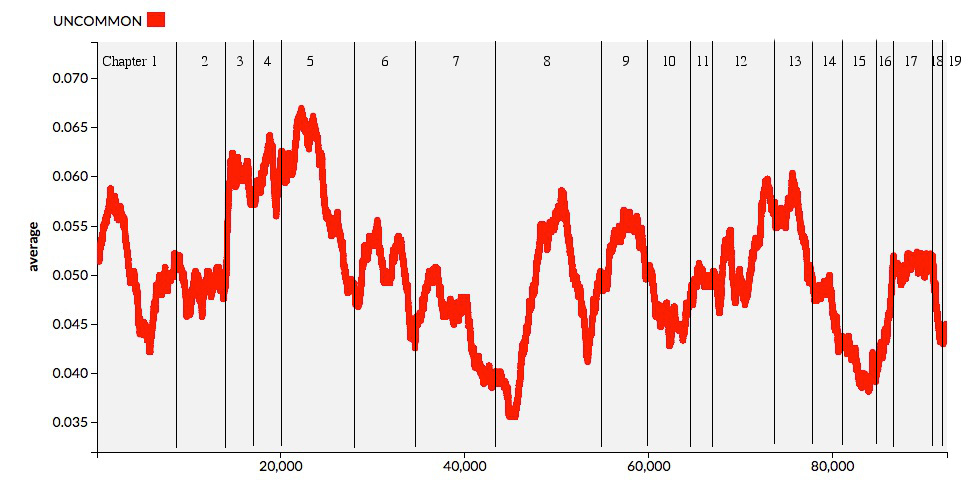
Update: the series of Uncommon Word graphs now have chapter markers, which I hope will help us all with interpreting the graphs.  The lines for the chapter breaks were added by me by hand to a layer in a GIMP file.  I used the Lexos graph’s tell-me-this-word-number function to see where the line should go.  In other words, this was an inexact process, but the results are close enough for a graph that shrinks 96,154 words into about 8 inches.

Further Update: the small labels in the Uncommon Word graphs have been successfully added at the suggestion of my Editor.

Denouement

And so we draw to a close.  Bilbo learns later what leads to the little trough at 92,000.  (Sidenote: I am confused why the Lexos graph ends just before word 93,000 as the last dot is labeled, even though the x-axis label seems to go to word 100,000.  We know from counting that the text file that Lexos read has 96,157 words.  I’ll research and report back, Word Fans.)

Uncommon5000GraphChap

[18.024] …But weariness left [the goblins’] enemies with the coming of new hope, and they pursued them closely, and prevented most of them from escaping where they could.

After this, a small rise through leave-takings and the safe, healing, restorative journey home.  Our tale ends where it began, in The Shire.  At the very end of this graph, the proportion of uncommon words is 0.044.  We’ve been here before, of course.  For those of you trying to draw a level line with your eyes, the trough of Chapter 1 measured in at 0.042.

[01.096] ‘Pardon me,’ he said, ‘if I have overheard words that you were saying.