The War Words

This is eerie.

2015.06.14 War Words

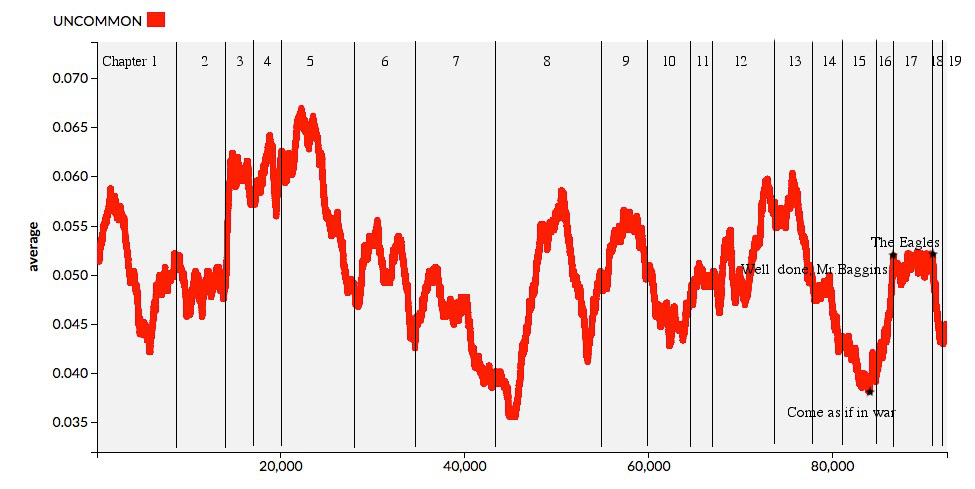
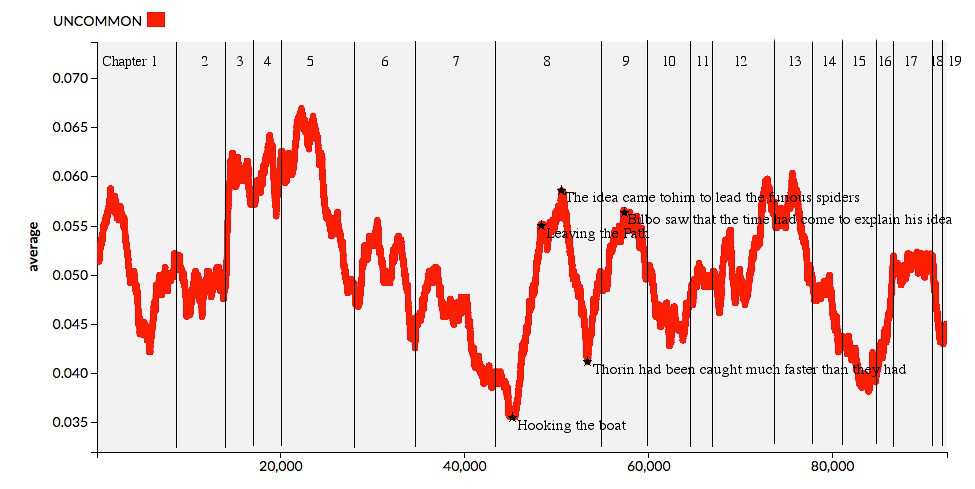
I can see the dragon-sickness and the evil it wreaks in this graph from word 75,000 to 84,000.  The exact trough, almost as low as our nadir of helplessness in Mirkwood, and perhaps even more hopeless, is here:

 [15.032] As they stood pointing and speaking to one another Thorin hailed them: ‘Who are you,’ he called in a very loud voice, ‘that come as if in war to the gates of Thorin son of Thrain, King under the Mountain, and what do you desire?’

And what restores hope?  You can see it, too.  Encoded in the frequency of uncommon words.  And what are the lines at word 86,644?

[16.042] … As they passed through the camp an old man, wrapped in a dark cloak, rose from a tent door where he was sitting and came towards them.

[16.043] ‘Well done! Mr. Baggins!’ he said, clapping Bilbo on the back. ‘There is always more about you than anyone expects!’ It was Gandalf.

The line holds fairly steady throughout the face off, the parleys, the tensions, the goblins and wargs and Dain and the bloodshed right up to the objectively measured, carefully calculated turning point in use of uncommon words.

[17.066] ‘The Eagles!’ cried Bilbo once more, but at that moment a stone hurtling from above smote heavily on his helm, and he fell with a crash and knew no more.
Climbing the Lonely Mountain

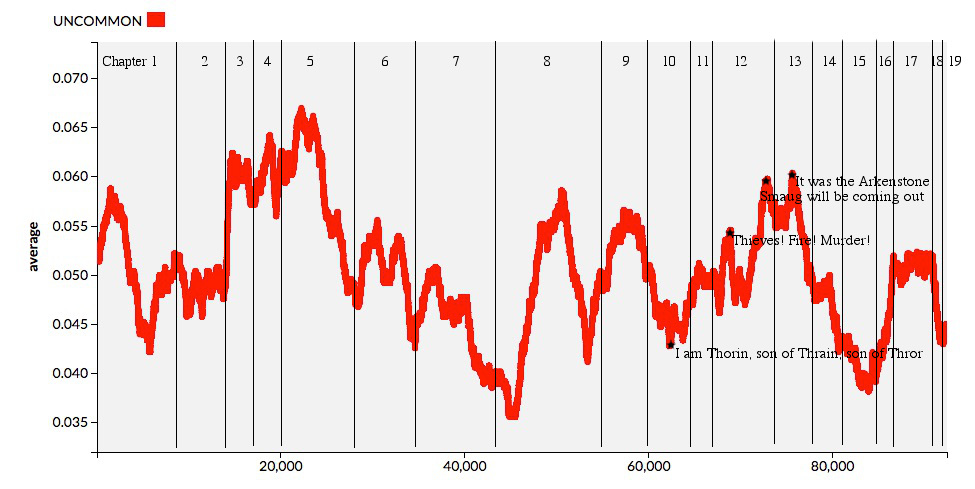
The low point near 62,000 surprised me.

[10.029] ‘I am Thorin son of Thrain son of Thror King under the Mountain! I return!’

Exactly there.  I had predicted that paragraph would be a high point of uncommon words since in my heart it is a high point of drama.  Instead, it is a turning point.  The words surrounding it have to do with being soggy and smelling of apples, so I understand the low point.  Remembering that our analysis ignores names, we can see that this phrase uses words so important that they are in common use.  Remembering that it’s a five thousand word window, I’m mightily impressed that it is the exact turning point.

2015.06.14 Lonely Mountain

We climb out of the barrels, climb through Laketown, climb the mountain, solve the thrush mystery, climb into the mountain, riddle with Smaug.  Our average of  uncommon words rises with a few local variations (the local peak is [12.021] Thieves! Fire! Murder! Such a thing had not happened since first he came to the Mountain! His rage passes description) to that double-peak surrounding 74,000 words:

[12.093] …Smaug will be coming out at any minute now, …
[13.019] It was the Arkenstone, the Heart of the Mountain.

Is your heart racing?  My heart is racing.

Uncommon Words: Revealing Adventures in Mirkwood

The area of the most common words, comes in Mirkwood.  Thorin and Company have been starving, the dark and depressing atmosphere weighing them down.

2015.06.14 Mirkwood

At the very nadir, [08.016], Bilbo peers into the darkness at the boat across the stream and Fili hooks it.  Suddenly – watch the line rise –  the deer appears, Thorin shoots, Bombur falls into the water, and at the top of that meteoric straight-line rise in the frequency of uncommon words,

[08.057]  they all left the path and plunged into the forest together.

From there, the differently-angled climbing peak in Mirkwood includes the drawing and naming of Sting, the moment that Bilbo decides to become a hero and lead the spiders away, and his spontaneous poetry!

We’re carefully remembering that each point on the graph represents the mid-point of a five-thousand word window – the stream-crossing and the drawing of Sting happen well within a single window whose point is on the sharply rising line.  Let’s also keep in mind that the word “spider” is among the uncommon words.  I am having fun looking at the specific points, however, and I hope you are as well, Word Fans.

Our adventures in Mirkwood are not quite over!  The dip at 53,000 comes a few pages before the end of chapter eight when the company is relieved to have been rescued and the perspective shifts to Thorin’s capture by the Wood-Elves.  The peak at 57,000 begins the daring Chapter 9 escape out of the Elvenking’s fortress.

A Slow Descent Into the Valley of Uncommon Words

Let’s take a look at the change after that sustained high frequency section.

Uncommon5000GraphChap

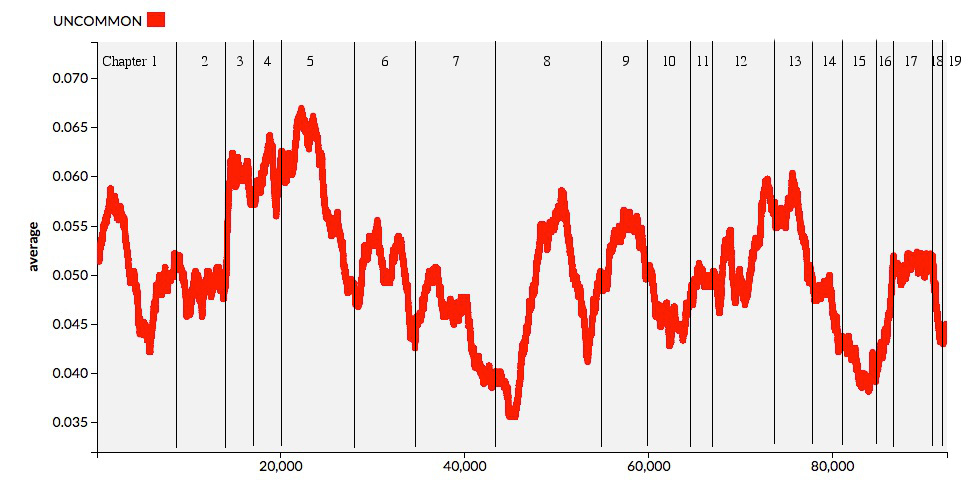
That small local low spot at 34,600 indicates the end of Chapter 6, Out of the Frying-Pan Into the Fire, when the excitement of goblins, wargs, and eagle-rides is ending.  The local peak immediately after it at 37,000 is the moment we meet Beorn.

The story continues to fall off in use of uncommon words until the nadir, which deserves its own post.

The Very Peak – Slightly Fluid.

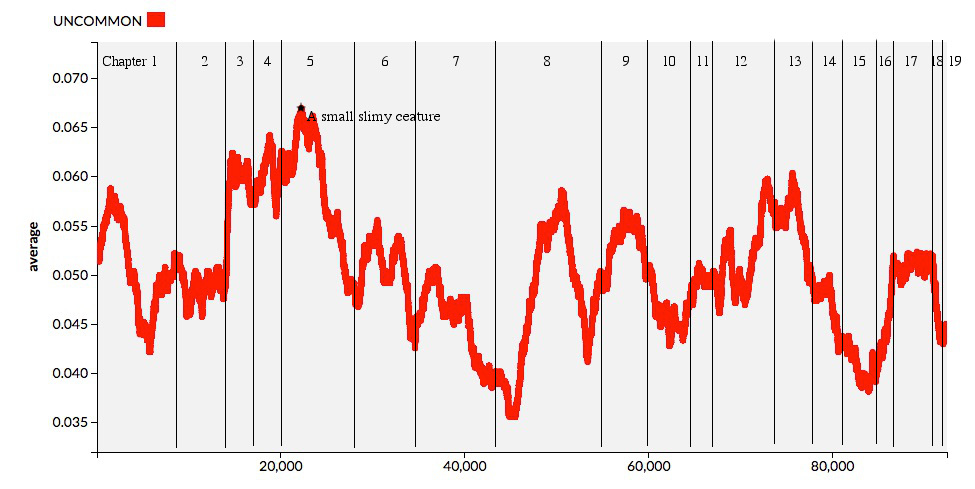
I’m looking closely at the very peak of our uncommon word graph.

2015.06.14 Fluid Peak

It comes right at the start of Chapter Five:

[05.012] Deep down here by the dark water lived old Gollum, a small slimy creature. I don’t know where he came from, nor who or what he was. …
[05.015] ‘Bless us and splash us, my precioussss! I guess it’s a choice feast; at least a tasty morsel it’d make us, gollum!’ And when he said gollum he made a horrible swallowing noise in his throat. That is how he got his name, though he always called himself ‘my precious’.

Is it a name?  Or a sound word?  In the current analysis, it’s counting as an uncommon word, a sound word.  I will be counting it as a sound word when we examine those separately, as it’s such an ingenious way of communicating the character’s dangerousness.  Of the 550 uncommon words in Chapter 5, “Gollum/gollum” accounts for only 100 of them.  The scene is terribly dense with uncommon words, thanks to Gollum’s manner of speaking.  May I give you a glimpse of my MarkWords file?

[05.048] After a while UNCOMMON began to UNCOMMON with pleasure to himself: ‘Is it nice, my UNCOMMON? Is it juicy? Is it UNCOMMON UNCOMMON?’ He began to peer at Bilbo out of the darkness.

[05.049] ‘Half a moment,’ said the hobbit UNCOMMON, ‘I gave you a good long chance just now.’

[05.050] ‘It must make UNCOMMON, UNCOMMON!’ said UNCOMMON, beginning to climb out of his boat

The Mountain Range of Uncommon Words

Time to explore the extended high region from about word 14,000 to 27,000.

2015.06.14 Mountain Range

The sharp increase comes right at the beginning of Chapter 3, A Short Rest.  The end of the sudden decline, here:

[05.127] ‘Thief, thief, thief! Baggins! We hates it, we hates it, we hates it for ever!’

To use recognizable landmarks, all these unusual words occur in Rivendell, among the goblins, and with Gollum.  We recall that unusual words are merely less-frequent, not high-register.  This sustained peak includes Gollum’s sibilant speech and the goblins’ “Clap! Snap! the black crack” poetry full of sound-play as well as the descriptions of Elrond’s sanctuary and his high speech and Thorin’s and Gandalf’s responses in kind.  Elves and goblins have their own languages and Gollum his own idiolect.  I believe that these unusual words twist our ears a little, knock us off of solid, prosy footing.  The slightly uncommon words are consistently so – enough to suggest the alien languages underlying these characters and places.

Chapter One: A Peak in Uncommon Words

This first local peak occurs in Chapter 1, and we must remember what it represents: the five thousand words surrounding this point contain a peak number of uncommon words.  Still it’s fun to see exactly what’s happening right at the peak:

Uncommon5000GraphChap

So apt.  This little peak comes at

[01.017]: You will notice already that Mr. Baggins was not quite so prosy as he liked to believe, also that he was very fond of flowers.

Yes, indeed, not prosy at all.  Perhaps even given to using uncommon words like “snapdragon” or “laburnums of fire”.  This five thousand word window looks in on plenty of uncommon words like “dwarves” and “dragon”.

You can see that this peak does not fall off immediately, the windows next to it contain “Far Over the Misty Mountains” at their edge.

Presenting: The Uncommon Words

It’s a beautiful sight!

Uncommon5000GraphChap

I have used a window of five thousand words this time, which shows the trends much more smoothly.  Let’s break this down and read what it is telling us in the next few posts.  Remember our Words Per Chapter list as you look over the graph.  The great news is that since I use Lexos directly on their web site, I can hover over any individual red dot and get the exact word number at the center of that window.  Zipping over to my electronic copy of The Hobbit, I can find that word and report back.

Tech Support is going to try to teach me how to use image-manipulating software to make a layer of chapter break lines to superimpose on each of these graphs.  If he succeeds, I will owe Tech Support a very big batch of blueberry muffins.

The Drawing Board

Very good.

We have a new text with everything MarkWords-ed, capitalized or no.  We have doublechecked our assumptions, gone back to the OED, and decided that “hobbit” is not uncommon.  It’s a Middle Earth word, created by Tolkien, such as any author might be free to name his characters and concepts.  “Hobbit” is not counting as an uncommon word in our analyses.  Now we’re ready to address “how did Tolkien do that?”  We’re looking at how uncommon words contribute to the register of the work.

Let’s make a graph!