Here it is for now, a tasty treat that Gollum enjoyed a few hours before Chapter 5.
- 05.087 and caught a small goblin-imp.
This word is not found in OED.
Here it is for now, a tasty treat that Gollum enjoyed a few hours before Chapter 5.
This word is not found in OED.
Richard Blackwelder writes:
There is no evidence in Tolkien’s biography that he was ever closely associated with horses, but I was struck with his feeling for them in the books.
Blackwelder went on to create a lovely monograph about the horses of The Hobbit and The Lord of the Rings, stringing together Tolkien’s passages concerning horses with “connective rephrasing” (Blackwelder’s term) to form a coherent description. Blackwelder’s mini-chapters are: In The Hobbit; The Pony of Sam Gamgee; The Horses of the Dark Lord; The Riders of Rohan; and Shadowfax.
For those of you who love onomastics, I note that Shadowfax is named in the style of Skinfaxi (pronounce “shine-faxi”) and Hrímfaxi, “Shining-mane” and “Frost-mane”, the horses of Day and Night in Norse mythology.
Because goblins eat horses, I have tagged this as a food word – scholars be careful only to use the 04.024 reference when researching food!
Blackwelder, Richard E. The Horses of Tolkien’s Middle Earth. Personal correspondence. July 8, 1980. Photocopy.
It’s definitely a lack-of-food word!
A feast is a celebratory religious observance, the contrast to a fast. The root of the word has more to do with “festival” and the religious meaning has more to do with antiphons than to do with food. Yet we apply the third meaning of a sumptuous meal to each of these instances. I wonder what could be made if we used the more religious definition?
“feast, n.” OED Online. Oxford University Press, March 2016. Web. 25 May 2016.
Caveat lector, sometimes these are animals and sometimes food. Fellow scholars exploring fish in the Hobbit must judge for themselves whether each instance is about a comestible. Almost all of them are in Chapter 5, just as we would wish them to be.
The staff of life! OED affirms that it’s but meal and moisture, kneaded and baked. The word comes from roots meaning “bit” or “piece” or “morsel”.
Before 1200 bread had quite displaced hláf as the name of the substance, leaving to the latter the sense ‘loaf’ (an amount, LFSA) which it has since retained. It thus appears that a word originally meaning ‘piece, bit, frustum’, has passed through the senses of ‘piece of bread’, ‘broken bread’, into that of ‘bread’ as a substance; while at the same time the original word for ‘bread, loaf, panis’ has been restricted to the undivided article as shaped and baked, the ‘loaf’. The Lowland Scotch and northern dialect use of piece illustrates anew the first step in this transition, for it is the regular word for a piece of bread, as in ‘give the bairn a piece’,
“bread, n.” OED Online. Oxford University Press, March 2016. Web. 18 May 2016.
In the excellent history of this word, “provision” has meant anything from food to providence to cold, hard cash. I’m thinking of
[02.116] Their own provisions were very scanty.
but do I include “provide” in my search? I think I do, since Latin pro-videre, to see ahead (and therefore remember to pack one’s pocket-handkerchief) clearly leads us to the noun pro-vision (oh! and look at the not incorrect but unexpected form pro-vidence up above!)
So! Not all of these are food words, friends, take care when you are doing your food research.
“provide, v.” OED Online. Oxford University Press, March 2016. Web. 18 May 2016.
“provision, n.” OED Online. Oxford University Press, March 2016. Web. 18 May 2016.
Is there something almost Kipling to the rhythm of this beautiful line?
[02.063] I’ll cook beautifully for you, a perfectly beautiful breakfast for you, if only you won’t have me for supper.”
Something like “Up jumped Nqua from his seat on the salt-flat and shouted “Go away!”
Kipling, Rudyard, and Nicolas. Just so Stories. New York: Doubleday, 1952. Print.
I was a little surprised to learn that “barrel” is a comparatively common word, so I checked more closely – it is approximately the nine-thousandth most common word in the Project Gutenberg corpus. It occurs mostly in Chapter Nine, of course. Note that in Chapter One, it does not refer to food.
We reach the signal word itself!
I am intrigued to compare our “uncommon food words” graph to the graph of this word: how intriguing! The scales are quite different, of course, the word “food” occurring only 39 times in the text. What interests me is that the word “food” pops up in regions where the uncommon food words are low…
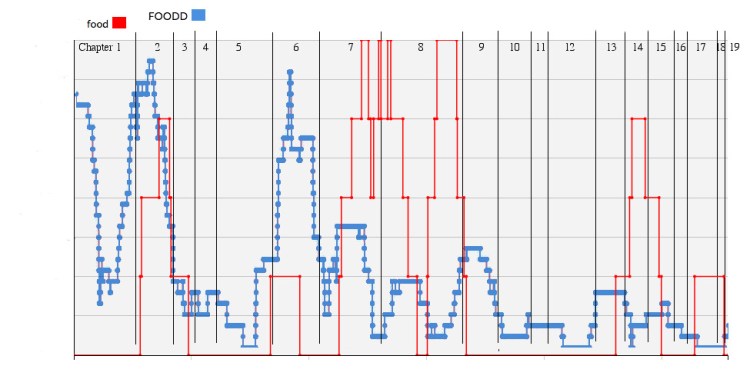
Once we’ve completed our survey of food, I am excited to see the graph of the entire repast!
 words that you were saying