Presenting: the Archaic Words

Next we take a look at the words we tagged “archaic”.  You’ll recall that we used this tag for any word labeled “obsolete” or “archaic” or “rare” or “regional” by the OED.

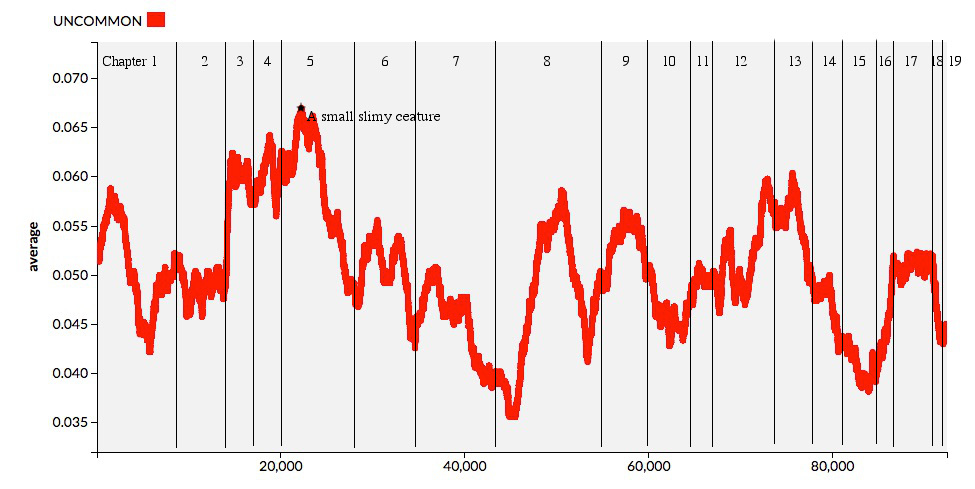
2015.06.15 Archaic & Uncommon Graph

Our first little peak occurs in the troll scene.  Hmm.  In that scene we have “canny” and “booby” tagged “archaic”, but that’s all.  Shall we think of this region as right between the Tra-la-la-lally elves and Rivendell?  It might be best if we do.

Low points for  goblins and wargs, I’m pleased to see, and a high point for the game of great antiquity!  I like that we have a peak once in the Elvenking’s halls, and am delighted that the exact phrase is at the start of the daring rescue.  Aside from Thranduil’s caverns, the incidence of archaic words grows simply from wargs through the climax at [18.017].  What are those particular words?

[18.017] ‘Farewell, good thief,’ he said. ‘I go now to the halls of waiting to sit beside my fathers, until the world is renewed. Since I leave now all gold and silver, and go where it is of little worth, I wish to part in friendship from you, and I would take back my words and deeds at the Gate.’
[18.018] Bilbo knelt on one knee filled with sorrow. ‘Farewell, King under the Mountain!’ he said. ‘This is a bitter adventure, if it must end so; and not a mountain of gold can amend it. Yet I am glad that I have shared in your perils – that has been more than any Baggins deserves.’
[18.019] ‘No!’ said Thorin. ‘There is more in you of good than you know, child of the kindly West. Some courage and some wisdom, blended in measure. If more of us valued food and cheer and song above hoarded gold, it would be a merrier world. But sad or merry, I must leave it now. Farewell!’

The only “archaic” tagged words in this passage are “merrier” and “merry”, and they qualified only under the technicalities of obsolete meanings of “enjoyable”. While the passage does not hold much in the way of archaisms, archaic words surround the passage like a chalice lifting it up – to be read carefully, sipped delicately, never forgotten.
Patterns in the Food Words

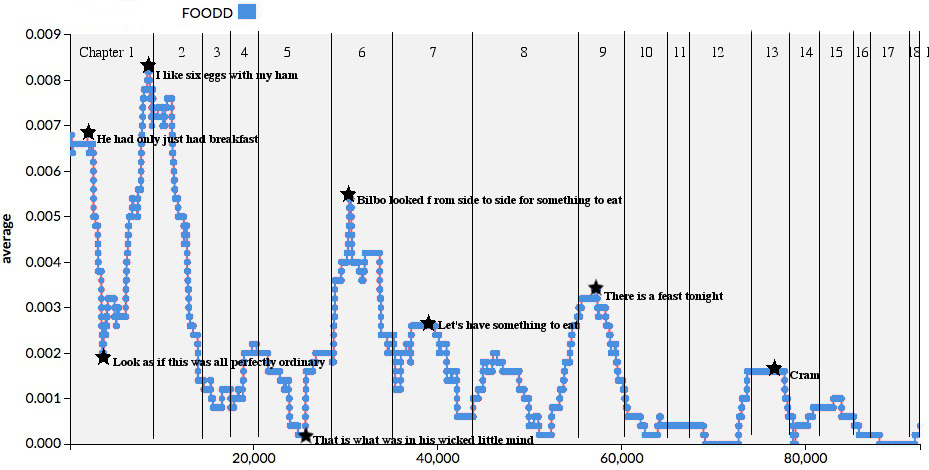
The region of densest Food words comes, as any of us might have predicted, in Chapter 1: The Unexpected Party.

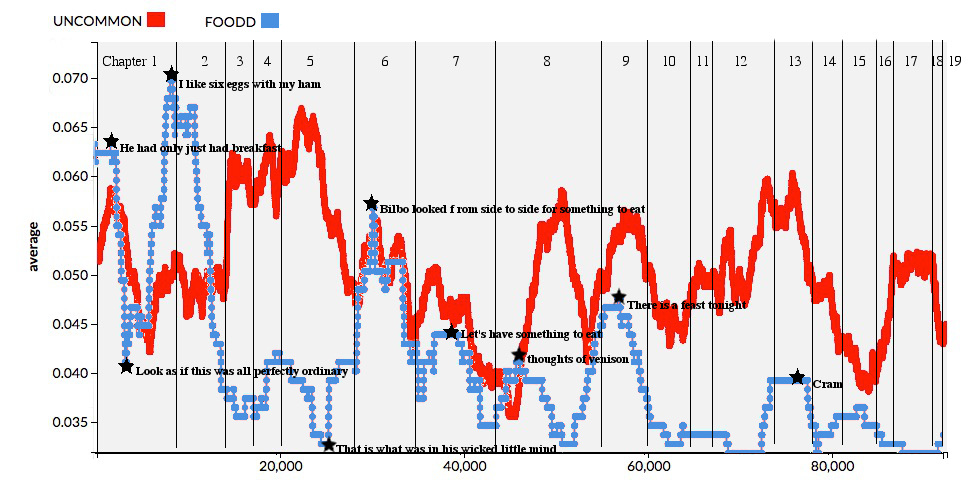
2015.07.02 Uncommon with Food

The unexpected dip in Chapter 1 comes just as the dwarves begin to help with the washing up.  Remember that there are plenty of food words from among our favorite and most-used vocabulary which are not tagged in this analysis – like chicken.   This dip graphically reminds us that we are only looking at a rolling average, not at the point itself.

The end of the Unexpected Party, with its orders for breakfast, contains the highest uncommon food average in the book  – and the beginning of the next chapter continues the trend: trolls have much to say about food (mutton, manflesh).  Bilbo’s not even thinking about food in Riddles in the Dark, of course, and chapter 6 is mostly about the lack of food and the presence only of tiny scrubby herbs.

[06.039] As they went on Bilbo looked from side to side for something to eat; but the blackberries were still only in flower, and of course there were no nuts, not even hawthorn-berries. He nibbled a bit of sorrel, and he drank from a small mountain-stream that crossed the path, and he ate three wild strawberries that he found on its bank, but it was not much good.

After that?  Not much food.  I’ve noted the relief at Beorn’s home, in the deer-shooting scene of Mirkwood, and before the Wood-elves’ feast.  Perhaps the discussion of “cram” is not so much a relief as dry, and possibly tasteless, fact.

(update 2015.07.02)

Presenting the Food Words

There are many fewer uncommon food words than simply uncommon words, therefore our graph is more granular, but the data were analyzed in the same manner, with a rolling average across a window of five thousand words.

2015.07.01 Food Word Graph with words

Our y-scale – average number of food words – is much smaller than the scale for the uncommon words.  It doesn’t even reach 0.01, and we talked about all common words being around 0.04 in Chapter 1.  Clearly if we scrunched the food words down to the same scale as all the uncommon words, we would barely notice their line.  So that we can see variation in food words, we’ll keep the graph at the same size as we superimpose it on the overall uncommon words.

To find my list of food words, just follow the “food” tag or click here.

I know for a fact the chicken and apples are in the Ten Thousand most common words – I challenge my fellow scholars to tag and analyze all the food words of The Hobbit!

Denouement

And so we draw to a close.  Bilbo learns later what leads to the little trough at 92,000.  (Sidenote: I am confused why the Lexos graph ends just before word 93,000 as the last dot is labeled, even though the x-axis label seems to go to word 100,000.  We know from counting that the text file that Lexos read has 96,157 words.  I’ll research and report back, Word Fans.)

Uncommon5000GraphChap

[18.024] …But weariness left [the goblins’] enemies with the coming of new hope, and they pursued them closely, and prevented most of them from escaping where they could.

After this, a small rise through leave-takings and the safe, healing, restorative journey home.  Our tale ends where it began, in The Shire.  At the very end of this graph, the proportion of uncommon words is 0.044.  We’ve been here before, of course.  For those of you trying to draw a level line with your eyes, the trough of Chapter 1 measured in at 0.042.

[01.096] ‘Pardon me,’ he said, ‘if I have overheard words that you were saying.

The War Words

This is eerie.

2015.06.14 War Words

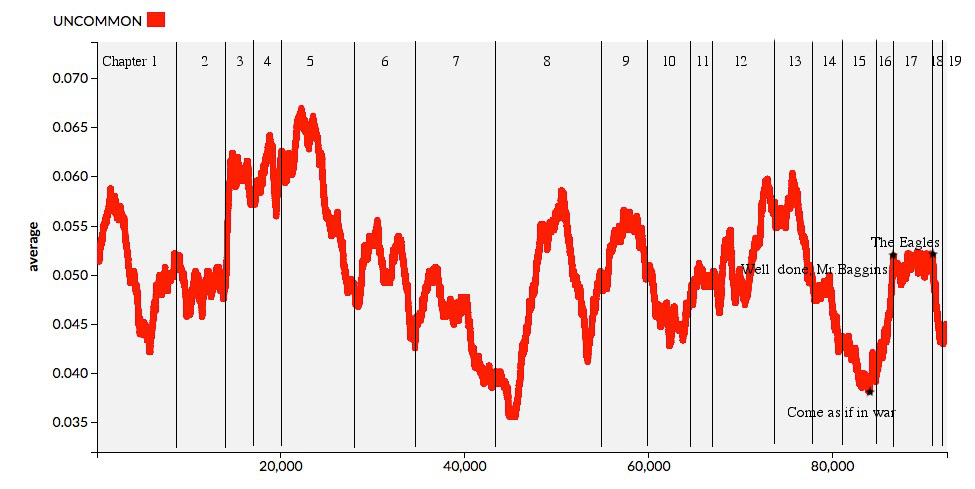
I can see the dragon-sickness and the evil it wreaks in this graph from word 75,000 to 84,000.  The exact trough, almost as low as our nadir of helplessness in Mirkwood, and perhaps even more hopeless, is here:

 [15.032] As they stood pointing and speaking to one another Thorin hailed them: ‘Who are you,’ he called in a very loud voice, ‘that come as if in war to the gates of Thorin son of Thrain, King under the Mountain, and what do you desire?’

And what restores hope?  You can see it, too.  Encoded in the frequency of uncommon words.  And what are the lines at word 86,644?

[16.042] … As they passed through the camp an old man, wrapped in a dark cloak, rose from a tent door where he was sitting and came towards them.

[16.043] ‘Well done! Mr. Baggins!’ he said, clapping Bilbo on the back. ‘There is always more about you than anyone expects!’ It was Gandalf.

The line holds fairly steady throughout the face off, the parleys, the tensions, the goblins and wargs and Dain and the bloodshed right up to the objectively measured, carefully calculated turning point in use of uncommon words.

[17.066] ‘The Eagles!’ cried Bilbo once more, but at that moment a stone hurtling from above smote heavily on his helm, and he fell with a crash and knew no more.

Climbing the Lonely Mountain

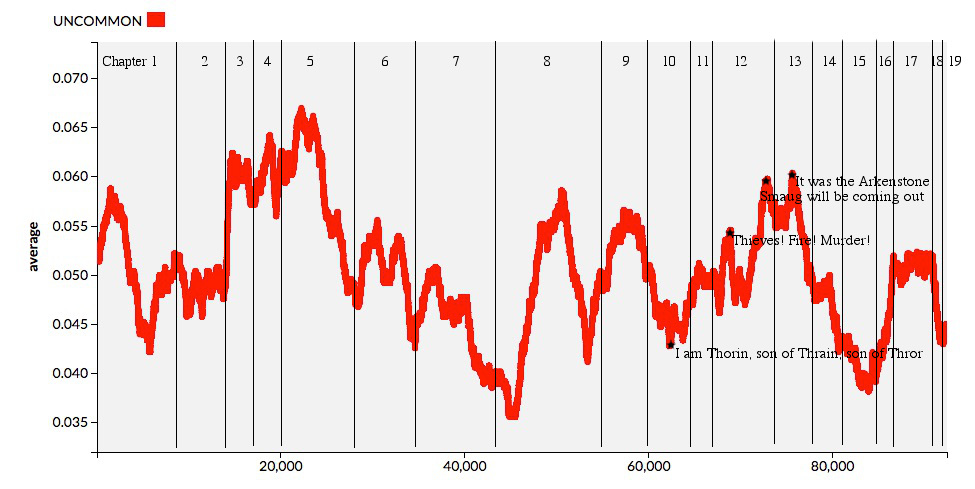
The low point near 62,000 surprised me.

[10.029] ‘I am Thorin son of Thrain son of Thror King under the Mountain! I return!’

Exactly there.  I had predicted that paragraph would be a high point of uncommon words since in my heart it is a high point of drama.  Instead, it is a turning point.  The words surrounding it have to do with being soggy and smelling of apples, so I understand the low point.  Remembering that our analysis ignores names, we can see that this phrase uses words so important that they are in common use.  Remembering that it’s a five thousand word window, I’m mightily impressed that it is the exact turning point.

2015.06.14 Lonely Mountain

We climb out of the barrels, climb through Laketown, climb the mountain, solve the thrush mystery, climb into the mountain, riddle with Smaug.  Our average of  uncommon words rises with a few local variations (the local peak is [12.021] Thieves! Fire! Murder! Such a thing had not happened since first he came to the Mountain! His rage passes description) to that double-peak surrounding 74,000 words:

[12.093] …Smaug will be coming out at any minute now, …
[13.019] It was the Arkenstone, the Heart of the Mountain.

Is your heart racing?  My heart is racing.

Uncommon Words: Revealing Adventures in Mirkwood

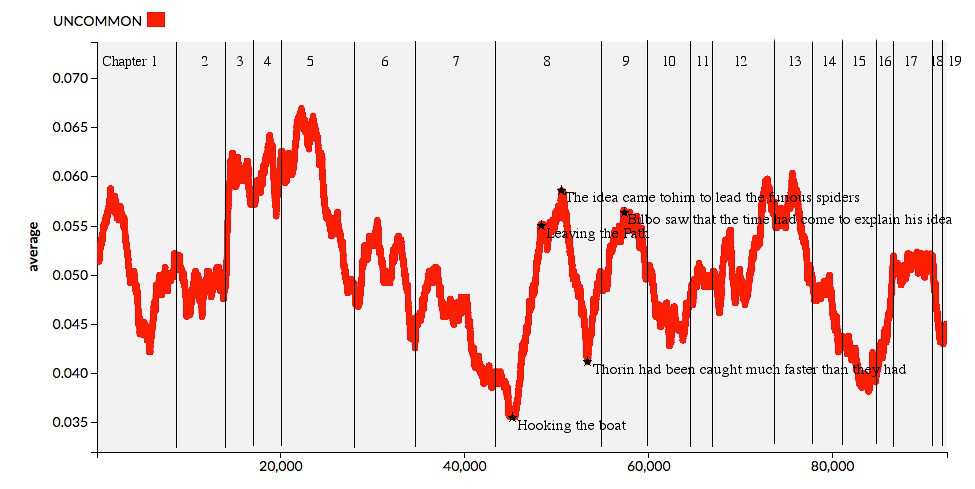
The area of the most common words, comes in Mirkwood.  Thorin and Company have been starving, the dark and depressing atmosphere weighing them down.

2015.06.14 Mirkwood

At the very nadir, [08.016], Bilbo peers into the darkness at the boat across the stream and Fili hooks it.  Suddenly – watch the line rise –  the deer appears, Thorin shoots, Bombur falls into the water, and at the top of that meteoric straight-line rise in the frequency of uncommon words,

[08.057]  they all left the path and plunged into the forest together.

From there, the differently-angled climbing peak in Mirkwood includes the drawing and naming of Sting, the moment that Bilbo decides to become a hero and lead the spiders away, and his spontaneous poetry!

We’re carefully remembering that each point on the graph represents the mid-point of a five-thousand word window – the stream-crossing and the drawing of Sting happen well within a single window whose point is on the sharply rising line.  Let’s also keep in mind that the word “spider” is among the uncommon words.  I am having fun looking at the specific points, however, and I hope you are as well, Word Fans.

Our adventures in Mirkwood are not quite over!  The dip at 53,000 comes a few pages before the end of chapter eight when the company is relieved to have been rescued and the perspective shifts to Thorin’s capture by the Wood-Elves.  The peak at 57,000 begins the daring Chapter 9 escape out of the Elvenking’s fortress.

A Slow Descent Into the Valley of Uncommon Words

Let’s take a look at the change after that sustained high frequency section.

Uncommon5000GraphChap

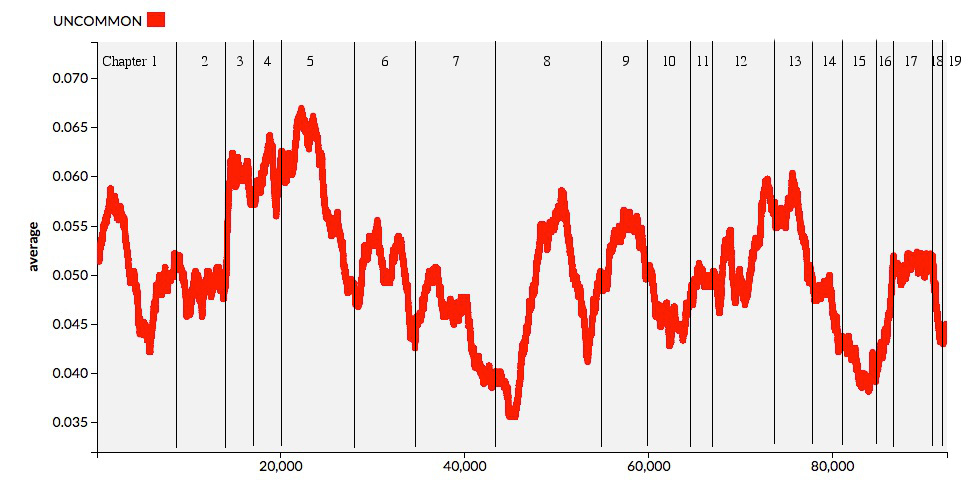
That small local low spot at 34,600 indicates the end of Chapter 6, Out of the Frying-Pan Into the Fire, when the excitement of goblins, wargs, and eagle-rides is ending.  The local peak immediately after it at 37,000 is the moment we meet Beorn.

The story continues to fall off in use of uncommon words until the nadir, which deserves its own post.

The Very Peak – Slightly Fluid.

I’m looking closely at the very peak of our uncommon word graph.

2015.06.14 Fluid Peak

It comes right at the start of Chapter Five:

[05.012] Deep down here by the dark water lived old Gollum, a small slimy creature. I don’t know where he came from, nor who or what he was. …
[05.015] ‘Bless us and splash us, my precioussss! I guess it’s a choice feast; at least a tasty morsel it’d make us, gollum!’ And when he said gollum he made a horrible swallowing noise in his throat. That is how he got his name, though he always called himself ‘my precious’.

Is it a name?  Or a sound word?  In the current analysis, it’s counting as an uncommon word, a sound word.  I will be counting it as a sound word when we examine those separately, as it’s such an ingenious way of communicating the character’s dangerousness.  Of the 550 uncommon words in Chapter 5, “Gollum/gollum” accounts for only 100 of them.  The scene is terribly dense with uncommon words, thanks to Gollum’s manner of speaking.  May I give you a glimpse of my MarkWords file?

[05.048] After a while UNCOMMON began to UNCOMMON with pleasure to himself: ‘Is it nice, my UNCOMMON? Is it juicy? Is it UNCOMMON UNCOMMON?’ He began to peer at Bilbo out of the darkness.

[05.049] ‘Half a moment,’ said the hobbit UNCOMMON, ‘I gave you a good long chance just now.’

[05.050] ‘It must make UNCOMMON, UNCOMMON!’ said UNCOMMON, beginning to climb out of his boat

The Mountain Range of Uncommon Words

Time to explore the extended high region from about word 14,000 to 27,000.

2015.06.14 Mountain Range

The sharp increase comes right at the beginning of Chapter 3, A Short Rest.  The end of the sudden decline, here:

[05.127] ‘Thief, thief, thief! Baggins! We hates it, we hates it, we hates it for ever!’

To use recognizable landmarks, all these unusual words occur in Rivendell, among the goblins, and with Gollum.  We recall that unusual words are merely less-frequent, not high-register.  This sustained peak includes Gollum’s sibilant speech and the goblins’ “Clap! Snap! the black crack” poetry full of sound-play as well as the descriptions of Elrond’s sanctuary and his high speech and Thorin’s and Gandalf’s responses in kind.  Elves and goblins have their own languages and Gollum his own idiolect.  I believe that these unusual words twist our ears a little, knock us off of solid, prosy footing.  The slightly uncommon words are consistently so – enough to suggest the alien languages underlying these characters and places.