Fish

Caveat lector, sometimes these are animals and sometimes food.  Fellow scholars exploring fish in the Hobbit must judge for themselves whether each instance is about a comestible.  Almost all of them are in Chapter 5, just as we would wish them to be.


  • 05.011 fish whose fathers swam in,
  • 05.011 also there are other things more slimy than fish.
  • 05.012 He was looking out of his pale lamp-like eyes for blind fish,
  • 05.012 Sometimes he took a fancy for fish from the lake,
  • 05.012 and sometimes neither goblin nor fish came back.
  • 05.050 a fish jumped out
  • 05.051 Fish!
  • 05.051 fish!’ he cried.
  • 05.051 It is fish!’
  • 05.054 talking of fish,
  • 05.054 Fish on a little table,
  • 05.087 and tired of fish.
  • 05.128 cold fish,
  • 14.007 Anything from floods to poisoned fish.
  • 14.018 and poisoned fish,
  • 16.018 That was no fish!’

Bread

The staff of life!  OED affirms that it’s but meal and moisture, kneaded and baked.  The word comes from roots meaning “bit” or “piece” or “morsel”.

Before 1200 bread had quite displaced hláf as the name of the substance, leaving to the latter the sense ‘loaf’ (an amount, LFSA) which it has since retained. It thus appears that a word originally meaning ‘piece, bit, frustum’, has passed through the senses of ‘piece of bread’, ‘broken bread’, into that of ‘bread’ as a substance; while at the same time the original word for ‘bread, loaf, panis’ has been restricted to the undivided article as shaped and baked, the ‘loaf’. The Lowland Scotch and northern dialect use of piece illustrates anew the first step in this transition, for it is the regular word for a piece of bread, as in ‘give the bairn a piece’,

  • 02.116 Now they had bread
  • 07.121 and fat again on bread
  • 08.145 and after he had got over his thankfulness for bread
  • 18.048 and eaten much of your bread.’

“bread, n.” OED Online. Oxford University Press, March 2016. Web. 18 May 2016.

Provision

In the excellent history of this word, “provision” has meant anything from food to providence to cold, hard cash.  I’m thinking of

[02.116] Their own provisions were very scanty.

but do I include “provide” in my search?  I think I do, since Latin pro-videre, to see ahead (and therefore remember to pack one’s pocket-handkerchief) clearly leads us to the noun pro-vision (oh!  and look at the not incorrect but unexpected form pro-vidence up above!)

So!  Not all of these are food words, friends, take care when you are doing your food research.

  • 01.002 provided with polished chairs,
  • 02.116 Their own provisions were very scanty.
  • 02.123 our small stock of provisions.
  • 03.034 and provisions light to carry
  • 07.126 He would provide ponies for each of them,
  • 07.126 I will provide you with skins for carrying water,
  • 08.007 for they were extremely careful with their provisions.
  • 10.045 and many provisions.
  • 11.001 with other provisions
  • 12.020 in size but provided with a bitter sword
  • 16.042 so an escort was provided for him,

“provide, v.” OED Online. Oxford University Press, March 2016. Web. 18 May 2016.

“provision, n.” OED Online. Oxford University Press, March 2016. Web. 18 May 2016.

Cook

Is there something almost Kipling to the rhythm of this beautiful line?

[02.063]  I’ll cook beautifully for you, a perfectly beautiful breakfast for you, if only you won’t have me for supper.”

Something like “Up jumped Nqua from his seat on the salt-flat and shouted “Go away!”

  • 01.142 and cook everybody else’s wretched breakfast.
  • 02.057 “And can yer cook ’em?” said Tom.
  • 02.063 “And please don’t cook me,
  • 02.063 I am a good cook myself,
  • 02.063 and cook better than I cook,
  • 02.063 and cook better than I cook,
  • 02.063 I’ll cook beautifully for you,
  • 03.024 “I can smell the wood-fires for the cooking.”
  • 06.099 and the figures of the dwarves round it cooking
  • 06.099 being used to having it delivered by the butcher all ready to cook.
  • 08.092 and cooking,

Kipling, Rudyard, and Nicolas. Just so Stories. New York: Doubleday, 1952. Print.

Barrel

I was a little surprised to learn that “barrel” is a comparatively common word, so I checked more closely – it is approximately the nine-thousandth most common word in the Project Gutenberg corpus.  It occurs mostly in Chapter Nine, of course.  Note that in Chapter One, it does not refer to food.

  • 01.113 with a long barrel
  • 02.043 Also there was a barrel of good drink at hand,
  • 02.049 Bert and Tom went off to the barrel.
  • 02.116 also one barrel of ale which was still full.
  • 05.144 and to sneak behind a big barrel
  • 09.001 Chapter IX BARRELS OUT OF BOND
  • 09.018 There stood barrels,
  • 09.018 and barrels, and barrels;
  • 09.018 and barrels, and barrels;
  • 09.019 Hiding behind one of the largest barrels
  • 09.019 From Lake-town the barrels were brought up the Forest River.
  • 09.020 When the barrels were empty
  • 09.020 and out the barrels floated on the stream,
  • 09.037 get the empty barrels
  • 09.038 in the sides of the barrels,
  • 09.048 they answered rolling the barrels to the opening.
  • 09.050 So they sang as first one barrel
  • 09.050 Some were barrels really empty,
  • 09.051 in a barrel himself,
  • 09.051 to the place where the barrels were collected.
  • 09.052 so as to let out the barrels as soon as they were all afloat below.
  • 09.054 Now the very last barrel
  • 09.054 into the cold dark water with the barrel on top of him.
  • 09.055 the barrel rolled round
  • 09.055 for you cannot count friends that are all packed up in barrels.
  • 09.056 even if he had managed to get astride his barrel,
  • 09.059 the eddying current carried several barrels
  • 09.059 up the side of his barrel
  • 09.060 Before long the barrels broke free again
  • 09.060 and the barrel was a good big one
  • 09.061 On the shallow shore most of the barrels ran aground,
  • 09.062 and pushed all the barrels together
  • 09.062 He slipped from his barrel
  • 09.064 They were making up a raft of barrels,
  • 09.065 The barrels now all lashed together
  • 10.004 shivering on the barrels,
  • 10.009 As soon as the raft of barrels came
  • 10.009 in the meanwhile the barrels were left afloat
  • 10.010 First of all a barrel was cut loose by Bilbo
  • 10.012 which were the right barrels.
  • 10.040 about keys or barrels while the dwarves stayed
  • 12.060 Maybe Barrel was your pony’s name;

Food

We reach the signal word itself!

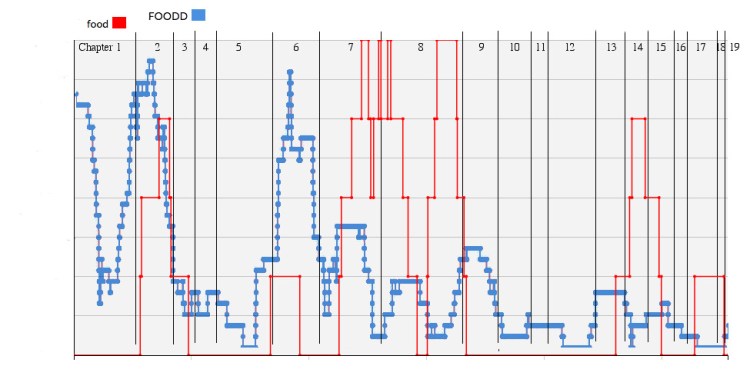
I am intrigued to compare our “uncommon food words” graph to the graph of this word: how intriguing!  The scales are quite different, of course, the word “food” occurring only 39 times in the text.  What interests me is that the word “food” pops up in regions where the uncommon food words are low…

2016.05.18.food vs uncommon foods

Once we’ve completed our survey of food, I am excited to see the graph of the entire repast!

  • 02.035 Of course it was mostly food,
  • 02.109 and food!”
  • 02.113 but there was a good deal of food
  • 02.116 and such food as was untouched
  • 03.005 “We need food,
  • 03.033 whether you liked food,
  • 03.034 Their bags were filled with food
  • 04.042 and no food,
  • 06.001 cloak, food, pony, his buttons
  • 06.061 especially to get food or slaves to work for them.
  • 07.012 We have no food,
  • 07.126 and he would lade them with food
  • 07.126 nor food.
  • 07.126 and nuts are about all that grows there fit for food;
  • 07.127 and the food I send with you.
  • 07.144 when the food begins to run short.’
  • 08.007 The food would not last for ever:
  • 08.036 was a poor exchange for packs filled with food however heavy.
  • 08.043 there was no food to go back to down below.
  • 08.046 and crumbs of food;
  • 08.052 and dream of food,
  • 08.059 with the one idea of begging for some food.
  • 08.060 for scraps of food for fear of becoming separated again.
  • 08.125 and where was there any food,
  • 08.140 Looking for food
  • 08.144 They gave him food
  • 09.010 and to be given food
  • 09.011 by stealing food
  • 10.011 If you want food,
  • 13.057 (and not altogether without food)
  • 13.062 but I see no sign of food.
  • 14.037 and food.
  • 14.038 and there was little food
  • 15.024 And little food to use!’
  • 15.028 for they had food for some weeks with care –
  • 18.019 If more of us valued food and cheer and song

Meal

This word is spectacular in its history!  Narrowly, the edible bit of the grain, the word comes ultimately from an IndoEuropean root which means something like “whirl” – as in meal that has been ground up by a mill.  “Meal” as a more general word for food, the “meal” that I am eating at this sitting, is the contrast word to “malt”, the beverage.

And Gollum?  Yes, he says “meal” in 05.055, in the now rare meaning of any powder produced by grinding.  We have a new word for the “archaic” tag!

  • 02.027 except of course when they stopped for meals.
  • 02.033 (who shared the hobbit’s views about regular meals,
  • 05.002 for he could feel inside that it was high time for some meal or other;
  • 05.055 Grinds hard stones to meal;
  • 06.035 he had not had a meal since the night before the night before last.
  • 07.129 and after the meal they mounted the steeds he was lending them,
  • 09.022 The evening meal had been taken
  • 10.011 that he had had at least one good meal
  • 12.060 in return for the excellent meal
  • 13.052 is the safest place for a meal.
  • 13.056 and other meals,

“meal, n.1.” OED Online. Oxford University Press, March 2016. Web. 12 May 2016.

Pot

Here are all the forms of “pot”, including searching for it as a verb and checking for “pottery”.  As a vessel for holding liquids or solids, it has both Germanic and Latin roots, but the etymology seems to be uncertain.  Oxford English Dictionary tells us:

The word in the Germanic and Romance languages and in post-classical Latin perhaps ultimately shows a loanword from a pre-Celtic language (perhaps Illyrian or perhaps a non-Indo-European substratal language), although a number of other etymologies have also been suggested.

Welsh pot (15th cent.), Irish pota (1475), and Scottish Gaelic poit are all apparently < (earlier than) English.

Please, fellow scholars, when you are charting and discussing “pot” note that sometimes pots carry food and other times they are for gold.

  • 02.001 Nearly every pot
  • 02.086 So they got a great black pot,
  • 02.113 to pots full of gold coins standing
  • 02.116 So they carried out the pots of coins,
  • 02.117 and carried away the pots of gold,
  • 06.074 Roast ’em alive, or stew them in a pot;
  • 07.126 and red earthenware pots of honey,
  • 12.011 like the noise of a large pot galloping on the fire,


“pot, n.1.” OED Online. Oxford University Press, March 2016. Web. 12 May 2016.

Bone

Like “fat”, most instances of “bone” don’t seem to be about food – yet some are.  You be the judge as you are tracking the food mentions in The Hobbit!

  • 01.065 Leave the bones on the bedroom mat!
  • 02.059 and boned.”
  • 02.113 There were bones on the floor
  • 05.054 the cat has the bones’ that of course is the answer,
  • 05.087 He still had a bone or two left to gnaw,
  • 06.078 fat melts, and bones black
  • 08.110 and leave your bones
  • 12.091 in my bones that this place will be attacked again.
  • 13.046 and bones were upon the floor
  • 14.043 There for ages his huge bones could be seen
  • 18.021 in his bones for the homeward journey.
  • 19.002 His bones are now crumbled;

Water

None can say better than Leonardo da Vinci:

“Water is sometimes sharp and sometimes strong, sometimes acid and sometimes bitter, sometimes sweet and sometimes thick or thin, sometimes it is seen bringing hurt or pestilence, sometime health-giving, sometimes poisonous. It suffers change into as many natures as are the different places through which it passes. And as the mirror changes with the colour of its subject, so it alters with the nature of the place, becoming noisome, laxative, astringent, sulfurous, salty, incarnadined, mournful, raging, angry, red, yellow, green, black, blue, greasy, fat or slim. Sometimes it starts a conflagration, sometimes it extinguishes one; is warm and is cold, carries away or sets down, hollows out or builds up, tears or establishes, fills or empties, raises itself or burrows down, speeds or is still; is the cause at times of life or death, or increase or privation, nourishes at times and at others does the contrary; at times has a tang, at times is without savor, sometimes submerging the valleys with great floods. In time and with water, everything changes”
  • 01.004 head of the hobbits who lived across The Water,
  • 01.005 that was to be found either under The Hill or over The Hill or across The Water,
  • 01.006 and across The Water
  • 01.013 You might try over The Hill or across The Water.’
  • 01.070 far over The Water
  • 01.083 Suddenly in the wood beyond The Water a flame leapt up –
  • 02.002 boiled water,
  • 02.019 across The Water,
  • 02.029 his cloak was full of water;
  • 02.087 We ain’t got no water,
  • 02.088 and yer can fetch the water yerself,
  • 03.007 showing where water might be.
  • 03.008 and running water at the bottom.
  • 03.011 They could hear the voice of hurrying water
  • 03.011 and there was a light on the valley-side across the water.
  • 03.024 across the water
  • 03.025 as quick as water flows,
  • 03.027 “It is long enough without watering it.”
  • 03.049 and then they went down to the water
  • 03.050 and the sun dancing on the water.
  • 04.002 – except by the noise of water
  • 05.010 he trotted splash into water!
  • 05.010 drops drip-drip-dripping from an unseen roof into the water below;
  • 05.011 in the water.
  • 05.012 Deep down here by the dark water
  • 05.012 if they ever came down alone anywhere near the edge of the water,
  • 05.047 who never had anything to do with the water if he could help it.
  • 05.050 in the water,
  • 05.056 He flapped into the water
  • 05.108 down to Gollum’s water.
  • 05.122 for he was leaving the water further
  • 06.065 and looking for water.
  • 07.117 but the water was too deep
  • 07.126 Water, he said,
  • 07.126 Water is not easy to find there,
  • 07.126 I will provide you with skins for carrying water,
  • 08.008 for they had none too much water,
  • 08.008 when one day they found their path blocked by a running water.
  • 08.008 in its water.
  • 08.015 which is low just there where the path goes down into the water.’
  • 08.018 in the water!
  • 08.029 and cleared the water with a mighty jump.
  • 08.030 and then toppled back into the dark water,
  • 08.031 above the water
  • 08.145 and meat and water,
  • 09.003 The water flowed dark and swift
  • 09.019 built out on bridges far into the water
  • 09.050 and was pushed over into the cold water some feet below.
  • 09.050 smacking into the water,
  • 09.054 Down into the water he fell,
  • 09.054 into the cold dark water with the barrel on top of him.
  • 09.055 Though his ears were full of water,
  • 09.055 in icy water,
  • 09.057 and whether a lot of water was getting into their tubs.
  • 09.057 in the water,
  • 09.058 He managed to keep his head above the water,
  • 09.059 The breeze was cold but better than the water,
  • 09.060 and being rather leaky had now shipped a small amount of water.
  • 09.061 and there it was joined to the main water of the Forest River
  • 09.061 There was a dim sheet of water no longer overshadowed,
  • 09.061 Then the hurrying water of the Forest River
  • 09.062 that he could see near the water’s edge.
  • 09.065 in the shallow water
  • 10.002 filled with the waters of the river which broke up
  • 10.002 but still a strong water flowed on steadily through the midst.
  • 10.003 and rains had swollen the waters
  • 10.005 the river gathered all its wandering waters together
  • 10.006 that any water that was not the sea could look so big.
  • 10.006 filled with deep waters
  • 10.006 the doubled waters poured out again
  • 10.007 and there had been fleets of boats on the waters,
  • 10.007 along the shores when the waters sank in a drought.
  • 10.010 through the shallow water to lie groaning on the shore.
  • 10.012 in the cold water
  • 10.021 and all the waters of the lake turn yellow right away.
  • 10.028 This was a wide circle of quiet water
  • 11.006 and gazing out from it over the narrow water,
  • 11.008 Out of it the waters of the Running River sprang;
  • 11.008 and the water,
  • 11.008 The only sound was the sound of the stony water,
  • 12.022 the waters rose
  • 12.054 and draws them alive again from the water.
  • 12.097 like water
  • 12.103 and up the water you came without a doubt.
  • 13.046 a sound of water fell upon their ears,
  • 13.048 there issued a boiling water,
  • 13.049 Now before them the water fell noisily outward
  • 13.064 but they forded the water without much difficulty,
  • 13.064 and water.
  • Chapter XIV FIRE and WATER
  • 14.011 in the town was filled with water,
  • 14.012 in deep water –
  • 14.015 though all had been drenched with water before he came.
  • 14.015 Once more water was flung by a hundred hands
  • 14.016 into the water on every side.
  • 14.028 He was drenched with water,
  • 14.042 but great store of goods he sent ahead by water.
  • 14.043 for ever after they had a dread of the water
  • 14.043 into the shivering water
  • 16.017 where he had to cross the water,
  • 16.017 and fell into the cold water with a splash.
  • 19.002 The white water flowing,
  • 19.005 and led them across the water to the house of Elrond.
  • 19.014 Hushed be all water, till dawn is at hand!
  • 19.023 The water was swollen
  • 19.037 and across the Water;