I have given this word its own entry in addition to entry in Grim because of our interest in hyphenated words. It refers, of course, to Bard. This word is not found in OED.
- 14.018 and grim-faced,
I have given this word its own entry in addition to entry in Grim because of our interest in hyphenated words. It refers, of course, to Bard. This word is not found in OED.
In all three cases referring to Bard – and although he speaks in a handful of chapters, it is only in chapter 14 that we see this word describing him.
I also talk about this word in the Grim entry, since we are interested in who and what are grim in any way, but out hyphen adventure leads me to separate “Grim-voiced” into its own entry as well. this compound word is JRRT original, not found in OED.
I took a dare for this summer, let’s see how I do. This post is a mini-concordance of the hyphenated words in the work as well as posts about hyphens, based on which we will explore some ideas about language and world-building. We have 402 hyphenated words to consider.
If you make them right, they’re easy to set up and then disassemble out of the way. They’re not exclusively for meals, though, so they’re not a food word.
Hyphenated in its sub-entry in OED.
“trestle, n.” OED Online, Oxford University Press, June 2017, http://www.oed.com/view/Entry/205619. Accessed 21 September 2017.
Here it is for now, a tasty treat that Gollum enjoyed a few hours before Chapter 5.
This word is not found in OED.
Today’s behind-the-scenes task has been to check all the hyphenated words in the Concordance. About 20% of them did not have the “hyphen” tag, and all have been fixed. I look forward to reading my fellow scholars’ work on the agglutinative nature of the Westron tongue based on these hyphenated words!
I had the great pleasure of talking with Tech Support about the graph I shared on July 10th:
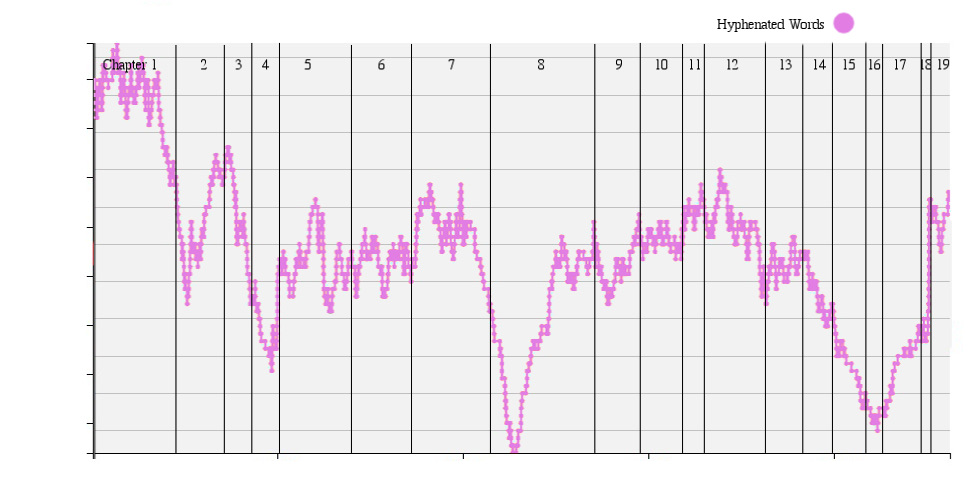
Tech Support made a few interpretations –
Shout-out to Mark Rosenfelder whose Language Construction Kit moved Tech Support from actively resisting the conventions of grammar (as nine-year-olds are wont to do) to giving Mama grammar lessons so she can do her thesis work.
I nourish ideas about the different people Bilbo encountered in Middle Earth and the different languages those people spoke (although they may all have spoken Bilbo’s own language to him during the adventure there and back again). I’ve mentioned a few times already that Tolkien uses a goodly number of hyphenated words which are not hyphenated in the OED (snow-peak, egg-question, check the Concordance for all 608 of them). Either they are separate words that he’s joined or compound words that he has separated. He even had made compound words of ones which the OED says are separate words or hyphenated! I thought of searching for these words to see if they show a particular region of Middle Earth which speaks a language that flexibly mooshes words together to express meaning more specifically. Would the right word for that be agglutinative?
Well, it’s easy enough to search on hyphens (fear not, I took out the dashes). I’m just going to leave this graph here for folks to nibble with their second breakfast.
I’m not sure what to make of it yet; my first approximation is that Westron, Bilbo’s native language, is the agglutinative one and that Mirkwood and the effects of dragon-sickness were both so depressing as to shock Bilbo out of his usual speech patterns.
Hyphenated in its OED sub-entry.
“tree, n.” OED Online, Oxford University Press, June 2017, http://www.oed.com/view/Entry/205416. Accessed 21 September 2017.
I’ve heard it pronounced “Inventory Reduction Specialist”…
Hyphenated in its OED sub-entry.
“treasure, n.” OED Online, Oxford University Press, June 2017, http://www.oed.com/view/Entry/205368. Accessed 21 September 2017.
 words that you were saying